Scientific Classification
| Kingdom: Animalia |
| Phylum: Mollusca |
| Class: Gastropoda |
| Order: Neogastropoda |
| Family: Pisaniidae |
| Genus: Bailya |
| Species: Bailya roycei (Smith, 1938) |
Information
Geological Range
Paleogeographic Distribution
Stratigraphic Occurrences
| Caloosahatchee Formation [Common] |
| Tamiami Formation (Pinecrest Beds) [Common] |
Remarks
Common name: n/a
Synonymy: n/a
Type specimen, locality, and stratum: n/a
Other voucher specimens: n/a
Descriptions:
Original Description (from M. Smith, 1938, p. 90):
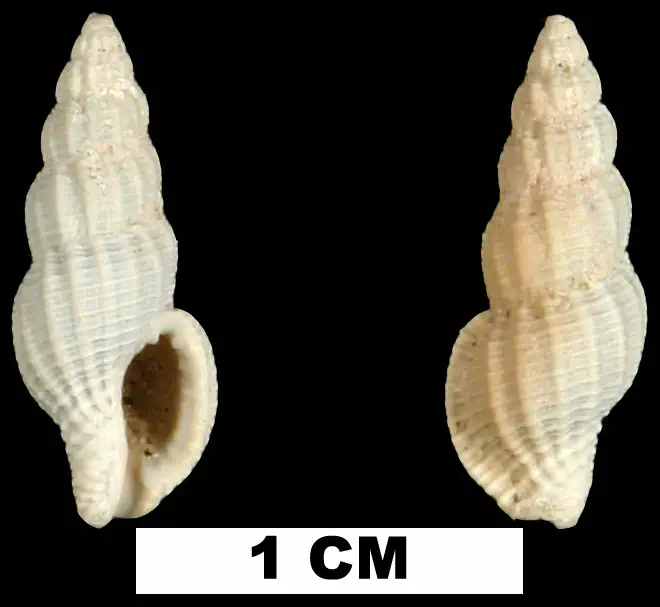
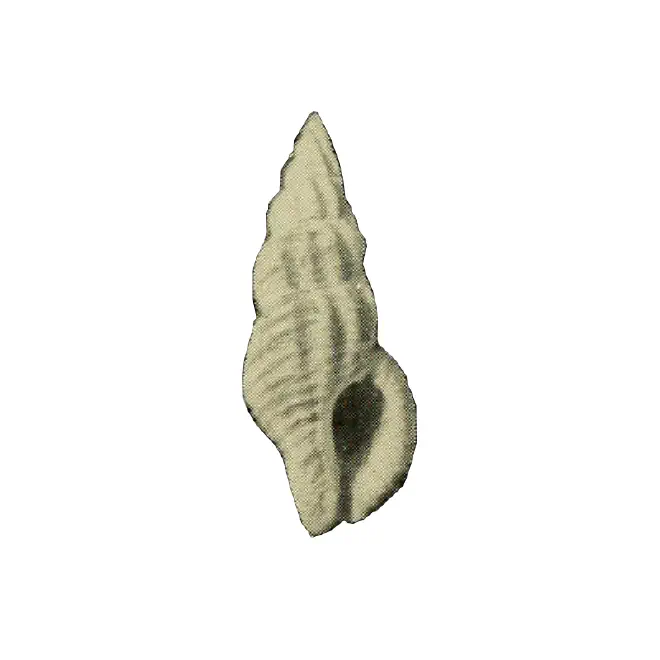
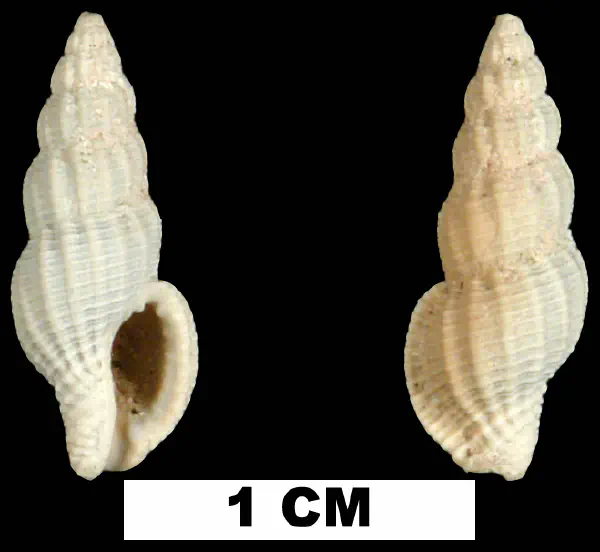
“Whorls six, in addition a smooth bulbous nucleus of 1.5 whorls; suture well impressed; about 11 axial ribs upon body whorl and a heavily expanded rib adjacent to the outer lip; about 14 strong spiral ribs upon body whorl and which also cover the axial ribs, occasional finer ribs between the former; posterior canal short but distinct; anterior canal moderately wide, deflected anteriorly; interior of outer lip grooved a short distance, parietal wall provided with irregularly placed short grooves or pustules. Length 13 mm.
This new Phos is related to Phos parvus intricatus Dall. In that species the sculpture differs considerably; the spiral ribs are much less uniform in size. On intricatus the spiral sculpture is dominant, on P. roycei the axial the most evident. The aperture of P. parvus is roughly half the length of the shell, relatively much longer and larger than in the new species. Viewing the two upon a plane surface P. roycei shows much greater deflection at the anterior end plus a longer canal.
In making comparisons a long series of living Phos parvus intricatus obtained by Winifred Royce at Key Largo, Florida, provided material for study. The new tertiary shell is associated with his name. The holotype is to be placed in the Museum of Comparative Zoology. PL 6, fig. 7. Pliocene, Clewiston, Florida.”
To access this description in its original formatting through the Biodiversity Heritage Library, click here.
Measurements: n/a
Other remarks: n/a
References: n/a
Online resources: n/a
Page history:
Some of the content on this page was originally published on the Neogene Atlas of Ancient Life on August 18, 2015. It was developed by Jonathan R. Hendricks and colleagues and migrated here in 2026.
This page was last modified on October 28, 2026 by Jonathan R. Hendricks.
Media
Images