
Scientific Classification
| Kingdom: Animalia |
| Phylum: Mollusca |
| Class: Gastropoda |
| Order: Neogastropoda |
| Family: Busyconidae |
| Genus: Busycon |
| Species: Busycon planulatum (Dall, 1890) |
Information
Geological Range
Paleogeographic Distribution
Stratigraphic Occurrences
| Caloosahatchee Formation |
| Nashua Formation |
| Tamiami Formation (Pinecrest Beds) |
Remarks
Synonymy: Fulgur (pyrum var.?) planulatum Dall, 1890: p. 114. Busycon cf. planulatum (Dall, 1890). Smith, 1946: p. 291, pl. 1, figs. 5-8. Busycon planulatum (Dall, 1890). Olsson and Harbison, 1953: p. 211, pl. 34, fig. 8 (ANSP 19060).
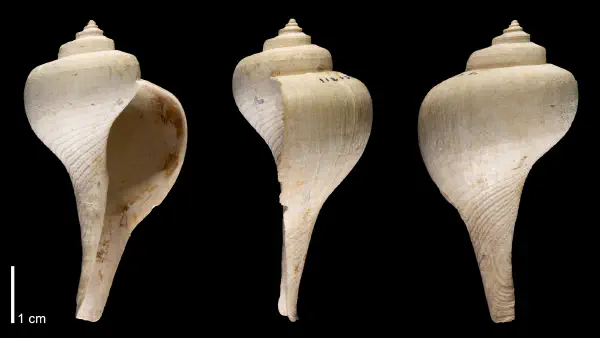
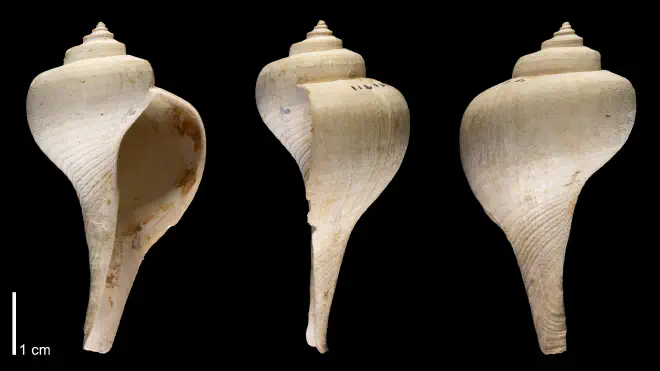
Type Specimen: USNM 112028 (holotype), “Near Fort Thompson, Caloosahatchie River, Florida” (Merrill, 1905, p. 276).
Original Description: From Dall (1890, p. 114): “Shell Creek, Willcox, Caloosahatchie marls, Dall. Shell small, six-whorled, with a small, smooth nucleus of one and a half whorls; the very small whorls immediately following the nucleus are spirally striate, with a flattish, relatively broad, minutely undulate or granular keel at the shoulder, behind which the whorl is flattish or slightly excavated, with a narrow and very feeble channel at the suture; beyond this the tubercles, keel and channel become obsolete, the shoulder subangular or almost rounded, the posterior surface of the whorls flat and smooth, and in front of the suture, which is wound on the exact periphery, there is only the faintest possible depression or rather downward slope to the preceding whorl; except for a few sparse, obsolete spiral lines, the periphery is smooth; the somewhat constricted base of the whorl is spirally threaded, with a tendency to alternation in strength; canal long, moderately slender; outer lip meeting the periphery nearly at right angles, simple, sharp-edged, nearly straight; body with little callus, pillar callous at the edge, sharply grooved; throat not lirate inside. Lon. 54, lat. 31 mm. This shell is exactly intermediate between the channelled and the unchannelled Fulgurs. If a specimen of pyrum with a scalar spire were to have the top of the whorls levelled off, the periphery become smooth and lose the liree of the outer lip, it would be something like this shell. One was found at Shell Creek by Mr. Willcox and one on the Caloosahatchie by the writer.
It does not seem possible that pyrum could vary to this extent, yet there is nothing else to compare it to, and the paucity of material makes me hesitate to regard it as absolutely distinct.”
Online Resources
References
Dall, W. D. 1890. Contributions to the Tertiary Fauna of Florida, with especial reference to the Miocene Silex-Beds of Tampa and the Pliocene beds of the Caloosahatchie River. Part I. Pulmonate, opisthobranchiate and orthodont gastropods. Transactions of the Wagner Free Institute of Science of Philadelphia, 3(1): 1-200, pls. 1-12. BHL.
Olsson, A. A., and A. Harbison. 1953. Pliocene Mollusca of southern Florida with special reference to those from north Saint Petersburg. With special chapters on Turridae by W. G. Fargo (pp. 365-409) and Vitrinellidae and fresh-water mollusks by H. A. Pilsbry (pp. 411-447). Academy of Natural Sciences of Philadelphia Monographs, 8: 1-457, 65 pls.
Smith, B. 1946. Observations on gastropod protoconchs. Part III. Some protoconchs in Busycon, Fusinus, Heilprinia, Hesperisternia, and Urosalpinx. Palaeontolographica Americana, 3(21): 289-302, 1 pl. BHL.
Media
Images
Page History
Page edited by Kelsey K. Engelke. Reviewed by Jonathan R. Hendricks and first posted March 25, 2026.