Scientific Classification
| Kingdom: Animalia |
| Phylum: Mollusca |
| Class: Gastropoda |
| Order: Caenogastropoda incertae sedis |
| Family: Turritellidae |
| Genus: Caviturritella |
| Species: Caviturritella alumensis (Mansfield, 1930) |
Information
Geological Range
Paleogeographic Distribution
Stratigraphic Occurrences
| Duplin Formation |
| Jackson Bluff Formation [Abundant] |
| Tamiami Formation (Pinecrest Beds) [Common] |
| Yorktown Formation [Questionable/rare] |
| Yorktown Formation (Lower) |
Remarks
Common name: n/a
Synonymy:
Previously listed as Turritella alumensis on the Neogene Atlas of Ancient Life.
Type specimen, locality, and stratum: n/a
Other voucher specimens: n/a
Descriptions:
Original Description (from Mansfield, 1930, p. 105):
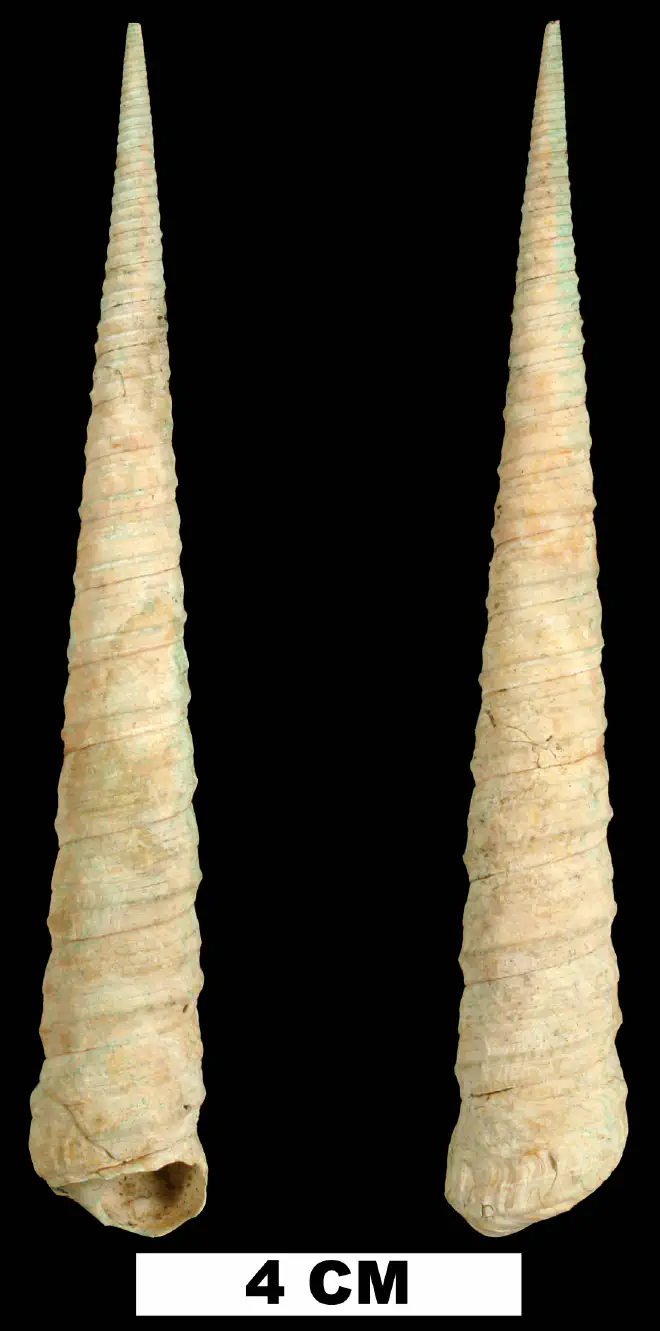
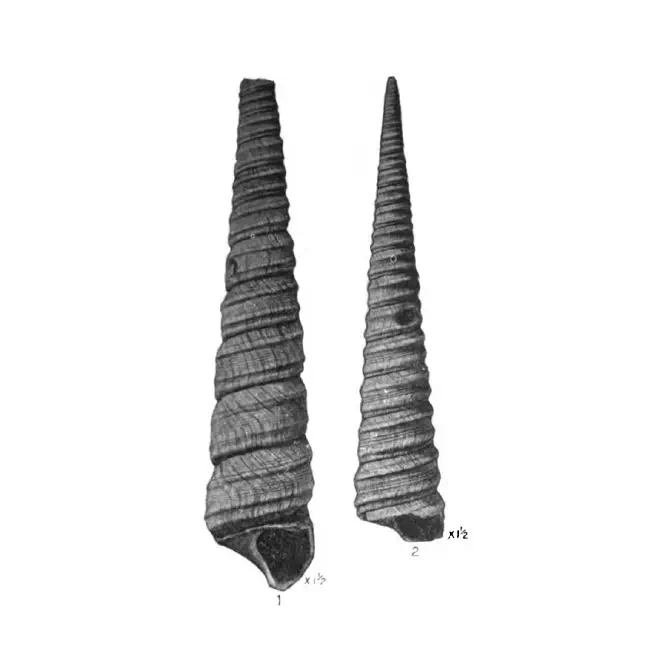
“Shell large, solid, moderately stout, probably of about 25 whorls on complete specimens. Suture impressed. Whorls nearly flat, medially depressed between primary spirals, upper whorls more so than later. Apical whorl rather large, flatly coiled, tip shallowly immersed. Spiral sculpture, on the earliest whorls, of a sharp basal keel. On ascending the whorl, another spiral begins below the suture, weak at first but later nearly equals in strength the basal one. Sculpture on later whorls of 3 primary spirals, one at the upper fourth and two at the anterior fourth and base. The basal spiral is weakest, the other two being of about equal strength. Aside from the primaries, flat secondary threads, usually intercalated by threadlets, overrun the surface.
Larger cotype with earlier whorls missing (U. S. Nat. Mus. Cat. No. 370319) measures: Altitude, 115 mm.; greatest diameter, 24 mm.
Occurrence: Upper Miocene: Upper bed at Alum Bluff, Liberty County, type locality (abundant); station 1/962, near Watsons Landing, Liberty County (rare?); station 1/960, Darlings Slide, Calhoun County (rare); station 3423, lower upper Miocene bed at Jackson Bluff, Leon County (common).
Turritella aguilerae Bose from near Tuxtepec, Mexico, is closely related to T. alumensis.
Specimens collected from the lower bed at Rushmere Wharf, James River, Va., are also nearly related to the Alum Bluff species.”
To access this description in its original formatting through Google Books, click here.
Measurements: n/a
Other remarks: n/a
References: n/a
Online resources:
Page history:
Some of the content on this page was originally published on the Neogene Atlas of Ancient Life on August 14, 2015. It was developed by Jonathan R. Hendricks and colleagues and migrated here in 2026.
This page was last modified on October 28, 2026 by Jonathan R. Hendricks.
Media
Images