
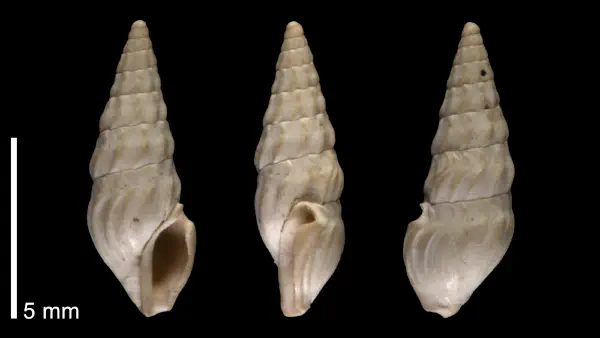
Scientific Classification
| Kingdom: Animalia |
| Phylum: Mollusca |
| Class: Gastropoda |
| Order: Neogastropoda |
| Family: Drillidae |
| Genus: Cerodrillia |
| Species: Cerodrillia perpolita (Dall, 1890) |
Information
Geological Range
Paleogeographic Distribution
Stratigraphic Occurrences
| Caloosahatchee Formation |
| Raysor Formation |
| Tamiami Formation (Pinecrest Beds) |
Remarks
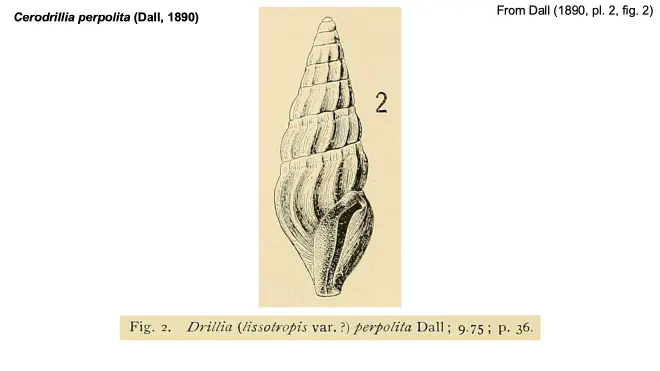
Synonymy: Drillia lissotropis Dall, 1890: p. 36, pl. 2, fig. 2.
Type Specimen: USNM 97332 (holotype). “Caloosahatchie River, near Fort Thompson, Florida” (Merrill, 1905, p. 235).
Other Combinations: Drillia lissotropis Dall, 1890 Cerodrillia perpolita (Dall, 1890) (Accepted name)
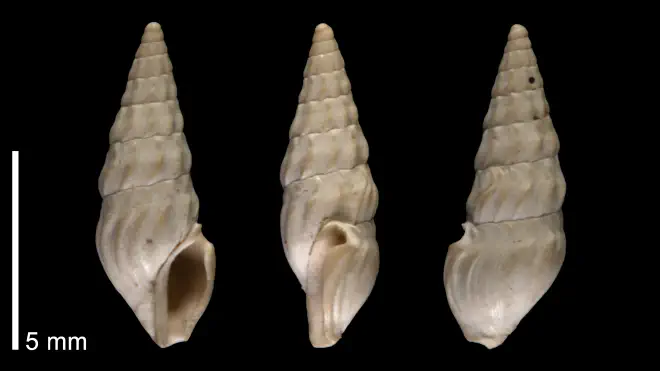
Original Description: From Dall, 1890 (p. 36):“Type, recent in the Gulf of Mexico and West Indies in 73 to 248 fathoms. Variety perpolita. Fossil in the Caloosahatchie beds. This shell differs from the recent D. lissotropis in the entire absence of the fine spiral striation which in nearly all specimens of lissotropis is visible between the ribs. It is uniformly stouter, the ribs are more widely separated and flexuous. The anal fasciole forms a moderate constriction which nearly cuts off the ends of the ribs where they abut on the suture behind them; these ends have therefore somewhat the appearance of a row of nodules. In D. lissotropis the fasciole is hardly perceptible, the ribs appear continuous and less sharp-edged than in perpolita. I consider it probably specifically distinct from D. lissotropis, which is, however, its nearest relative. The max. lon. of D. perpolita is 9.75; max. lat. 3.0 mm.”
Online Resources
MolluscaBase record 1820044, as Drillia perpolita.
References
Dall, W. D. 1890. Contributions to the Tertiary Fauna of Florida, with especial reference to the Miocene Silex-Beds of Tampa and the Pliocene beds of the Caloosahatchie River. Part I. Pulmonate, opisthobranchiate and orthodont gastropods. Transactions of the Wagner Free Institute of Science of Philadelphia, 3(1): 1-200, pls. 1-12. BHL
Media
Images
Page History
Page edited by Kelsey K. Engelke. Reviewed by Jonathan R. Hendricks and first posted April 1, 2026.