
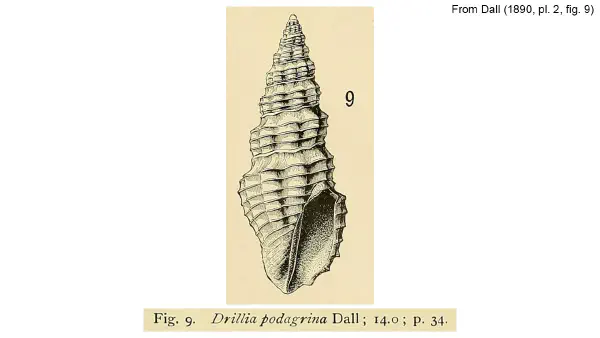
Scientific Classification
| Kingdom: Animalia |
| Phylum: Mollusca |
| Class: Gastropoda |
| Order: Neogastropoda |
| Family: Drillidae |
| Genus: Clathrodrillia |
| Species: Clathrodrillia podagrina (Dall, 1890) |
Information
Geological Range
Paleogeographic Distribution
Stratigraphic Occurrences
| Caloosahatchee Formation |
| Jackson Bluff Formation |
| Duplin Formation |
| Tamiami Formation (Pinecrest Beds) |
Remarks
Synonymy: Drillia podagrina (Dall, 1890): p. 34, pl. 2, fig. 9.
Other Combinations: Drillia podagrina Dall, 1890 Clathrodrillia podagrina (Dall, 1890) (Accepted name)
Type Specimen: USNM 97324 (holotype), “Caloosahatchie River, near Fort Thompson, Florida” (Merrill, 1905, p. 236).
Original Description: From Dall, 1890 (p. 34):“Rare in the Caloosahatchie beds. Shell elongated, acute, sharply sculptured, with a very small, smooth nucleus; spiral sculpture on the later whorls of (between the sutures three, on the last whorl eight or nine) rather fine, elevated, clean-cut even threads, not enlarged where they pass over the ribs; there are also a few close threads on the canal and one in front of the suture, beside a uniform, extremely fine spiral striation, only visible with a lens, which covers the whole shell; transverse sculpture of (on the last whorl ten) rounded ribs, strongest just in front of the fasciole, where they shoulder the whorl and extend forward to the canal; fasciole rather wide, well excavated and somewhat undulated by the ribs; terminal varix not very marked; notch deep, rather wide ; aperture moderate, with a well-marked callus on the pillar; canal short, rather strongly recurved, which, with a sort of constriction behind the canal, gives the siphonal fasciole great prominence, while there is a shallow chink behind the callus of the pillar, Max. lon. of shell 14.0; max. lat. 5.3 mm.
This is an elegantly sculptured little species, not very close to any of the preceding.”
Online Resources
References
Dall, W. D. 1890. Contributions to the Tertiary Fauna of Florida, with especial reference to the Miocene Silex-Beds of Tampa and the Pliocene beds of the Caloosahatchie River. Part I. Pulmonate, opisthobranchiate and orthodont gastropods. Transactions of the Wagner Free Institute of Science of Philadelphia, 3(1): 1-200, pls. 1-12. BHL
Media
Images

Page History
Page edited by Kelsey K. Engelke. Page reviewed by Jonathan R. Hendricks and first posted March 30, 2026.