Scientific Classification
| Kingdom: Animalia |
| Phylum: Mollusca |
| Class: Gastropoda |
| Order: Littorinimorpha |
| Family: Calyptraeidae |
| Genus: Crepidula |
| Species: Crepidula plana Say, 1822 |
Information
Geological Range
Paleogeographic Distribution
Stratigraphic Occurrences
| Anastasia Formation [Uncommon] |
| Coffee Mill Hammock Formation [Uncommon] |
| Flanner Beach Formation [Uncommon] |
| Fort Thompson Formation [Common] |
| Neuse Formation [Questionable/rare] |
| Norfolk Formation [Uncommon] |
| Pamlico Formation [Questionable/rare] |
| Satilla Formation [Questionable/rare] |
| Bermont Formation [Common] |
| Canepatch Formation [Uncommon] |
| Caloosahatchee Formation [Common] |
| Chowan River Formation [Questionable/rare] |
| James City Formation [Uncommon] |
| Nashua Formation [Common] |
| Waccamaw Formation [Common] |
| Duplin Formation [Common] |
| Duplin / Raysor Formations [Uncommon] |
| Jackson Bluff Formation [Common] |
| Mare Formation (Lower) |
| Raysor Formation [Common] |
| Tamiami Formation (Pinecrest Beds) [Abundant] |
| Yorktown Formation [Common] |
| Chagres Formation |
| Gatun Formation (Lower) |
| Shoal River Formation |
| St. Marys Formation |
| Chipola Formation |
| Oak Grove Sand |
Remarks
Common name: Eastern white slippersnail.
Synonymy: n/a
Type specimen, locality, and stratum: n/a
Other voucher specimens: n/a
Descriptions:
Original Description (from Say, 1822, p. 226-227):
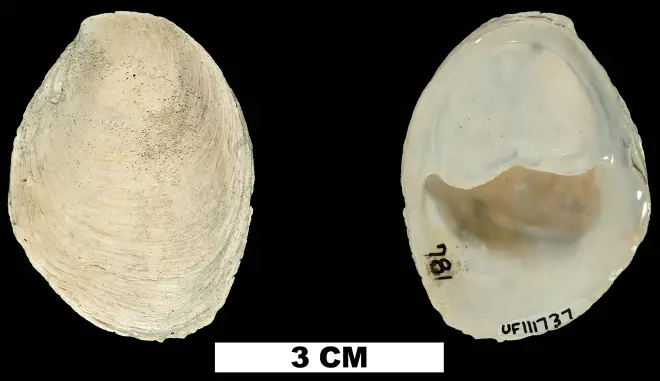
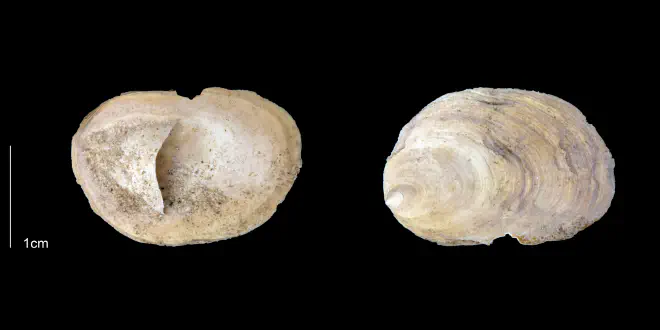
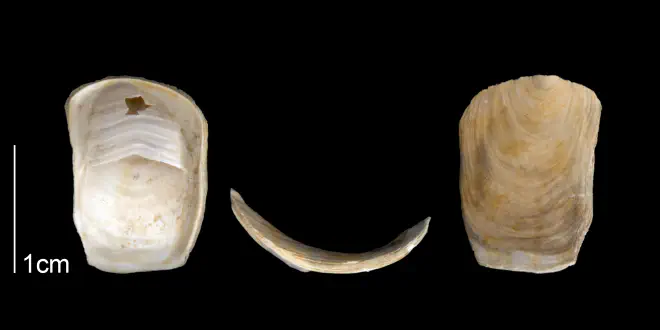
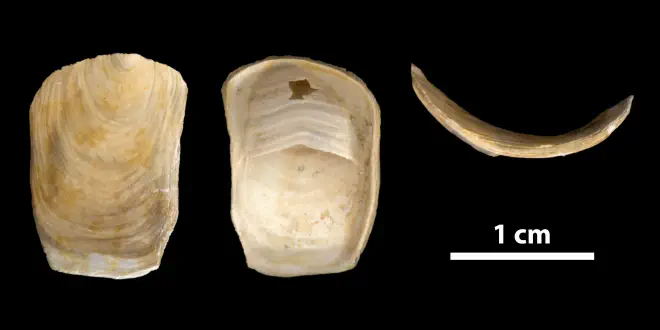
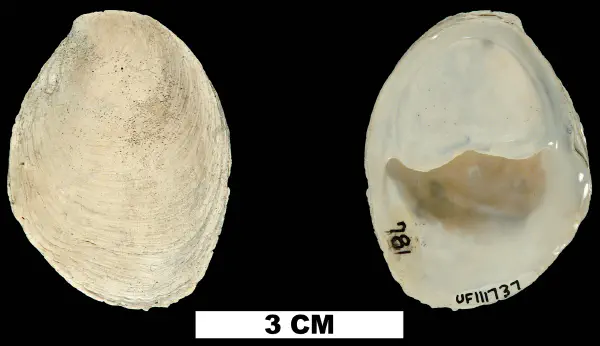
“Shell depressed, flat, oblong oval, transversely wrinkled, lateral margins abruptly deflected; apex not prominent, and constituting a mere terminal angle, obsolete in the old shells; within white; diaphragm occupying half the length of the shell, convex, contracted in the middle and at one side.
Length 1 and 1-10 of an inch.
Inhabits the coast of the United States.
Cabinet of the Academy and Philadelphia Museum.
A remarkably distinct species, the surface of the shell is flat, and sometimes slightly concave. The young shell is generally orbicular, and gradually becomes proportionally more elongated as it increases in size. I have found it on the coasts of Maryland, Carolina, Georgia and East Florida, and my brother, Mr. Benjamin Say, discovered it on the shores of New Jersey.”
To access this description in its original formatting through the Biodiversity Heritage Library, click here.
Measurements: n/a
Other remarks:
For information on the modern distribution of the species, see Malacolog and WoRMS.
Stratigraphic notes: St. Marys Formation: Age not resolved beyond “Miocene”.
References: n/a
Online resources:
Page history:
Some of the content on this page was originally published on the Neogene Atlas of Ancient Life on January 31, 2015. It was developed by Jonathan R. Hendricks and colleagues and migrated here in 2026.
This page was last modified on October 28, 2026 by Jonathan R. Hendricks.
Media
Images