Scientific Classification
| Kingdom: Animalia |
| Phylum: Mollusca |
| Class: Gastropoda |
| Order: Neogastropoda |
| Family: Muricidae |
| Genus: Dermomurex |
| Species: Dermomurex alabastrum (Adams, 1864) |
Information
Geological Range
Paleogeographic Distribution
Stratigraphic Occurrences
| Bermont Formation [Questionable/rare] |
| Caloosahatchee Formation [Common] |
| Moin Formation |
| Tamiami Formation (Pinecrest Beds) [Common] |
Remarks
Common name: n/a
Synonymy: n/a
Type specimen, locality, and stratum: n/a
Other voucher specimens: n/a
Descriptions:
To access the original description by A. Adams (1864) in its original formatting through the Biodiversity Heritage Library, click here.
First English Description (from Dall, 1892, p. 243-244):
“Pliocene beds of Florida at Shell Creek, Willcox.
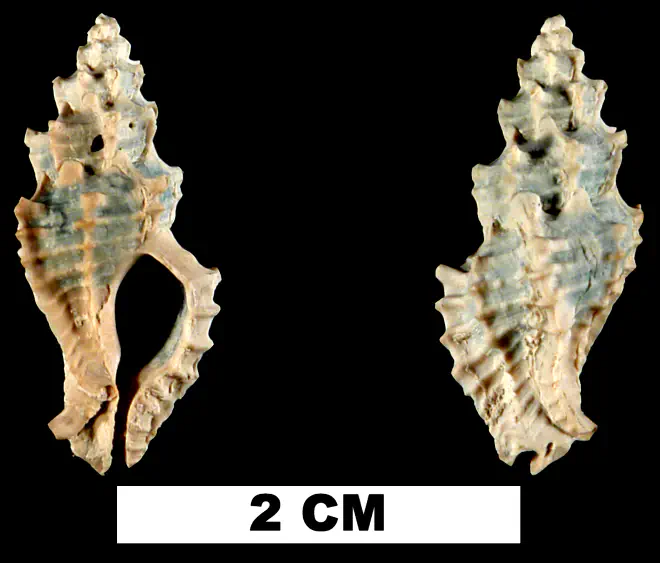
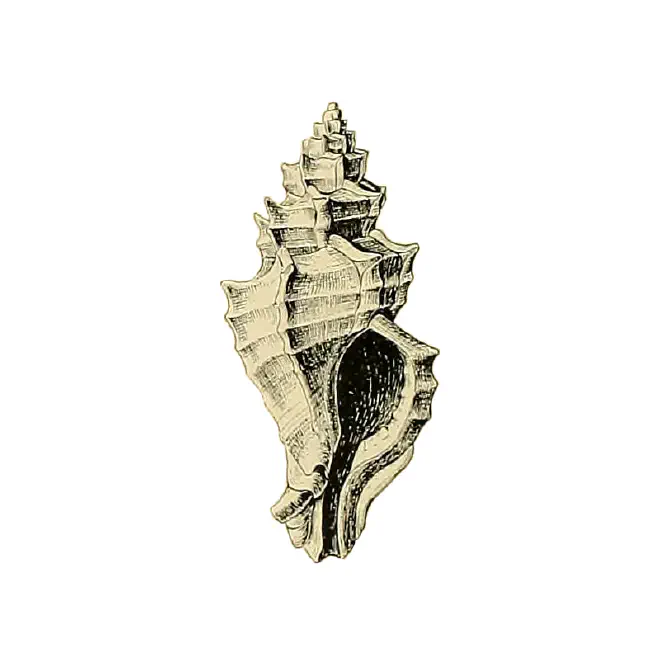
Shell elevated, with prominent sculpture and eight whorls; nucleus small, smooth, of two and a quarter whorls; remaining whorls each with three principal and three minor varices, which are thin, sharp and spinose at the intersection of the spiral ribs, especially at the shoulder; whole surface covered with a thin limy coat, evenly and finely spirally striate, but this coating is usually partly worn off, being very perishable; other spiral sculpture of three (on the last whorl 6) sharp, narrow, elevated spiral riblets which overrun the varices, and (especially on the major varices) tend to form spines at the intersection; the spiral rib at the shoulder is especially prominent and tends to turriculate the whorls; whorls full, rounded under the sculpture; aperture ovate; canal long, open, narrow, much recurved; outer lip with a few coarse lirae within in the adult. Alt. 28; max. diam. 12 mm.
This species closely resembles, when adult, the recent Aspella obeliscus A. Adams, but differs from it by the narrowness and sharpness of the varices and spirals, and by the spinous projections at the shoulder. The internal liras of the outer lip are fewer and coarser than in A. obeliscus and the varices are not continuous up the spire with such unvarying precision in the fossil as in the recent shell. T. engonatus is with little doubt the Pliocene ancestor of the recent obeliscus. The specimen figured is not quite adult, but shows the sculpture better than an older specimen. The limy coat characteristic of the group is so easily detached that few of the shells have more than small patches of it remaining.”
To access this description in its original formatting through the Biodiversity Heritage Library, click here.
Measurements: n/a
Other remarks:
For information on the modern distribution of the species, see Malacolog.
Stratigraphic notes: Moin Formation: Extends into Lower Pleistocene.
References: n/a
Online resources:
Page history:
Some of the content on this page was originally published on the Neogene Atlas of Ancient Life on July 21, 2014. It was developed by Jonathan R. Hendricks and colleagues and migrated here in 2026.
This page was last modified on October 28, 2026 by Jonathan R. Hendricks.
Media
Images