
Scientific Classification
| Kingdom: Animalia |
| Phylum: Mollusca |
| Class: Gastropoda |
| Order: Neogastropoda |
| Family: Echinofulguridae |
| Genus: Echinofulgur |
| Species: Echinofulgur echinatum (Dall, 1890) |
Information
Geological Range
Paleogeographic Distribution
Stratigraphic Occurrences
| Caloosahatchee Formation |
| Nashua Formation |
| Tamiami Formation (Pinecrest Beds) |
| Tamiami Formation |
| Tamiami Formation (Lower) |
Remarks
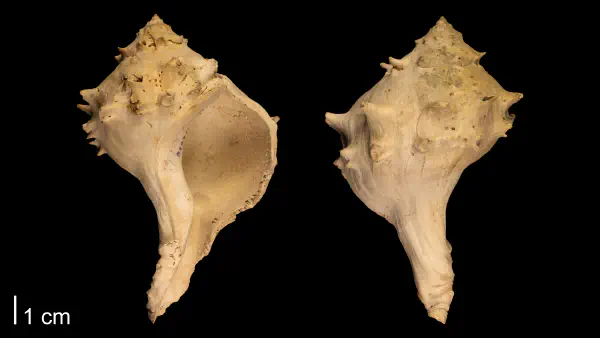
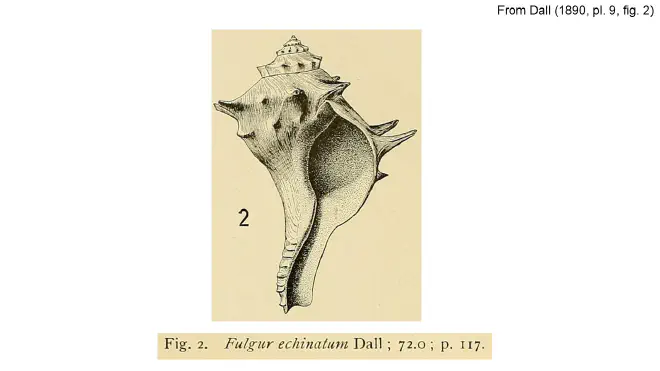
Synonymy: Fulgur echinatum (Dall, 1890): p. 117, pl. 9, fig. 2.
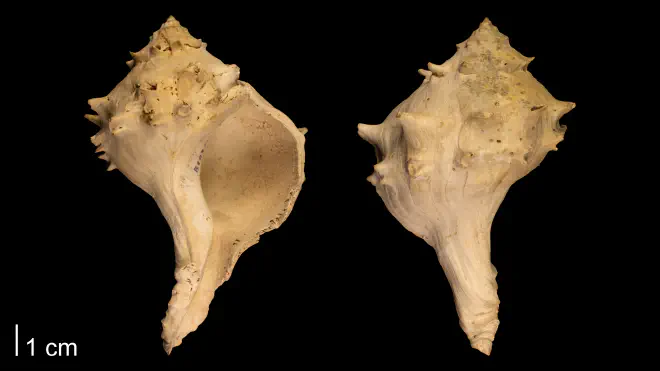
Type Specimen: USNM 112018 (holotype), “Near Fort Thompson, Caloosahatchie River, Florida” (Merrill, 1905, p. 276).
Original Description: From Dall, 1890 (p. 117):“Shell dextral, short, with a stout body and seven or eight whorls; nucleus small, smooth, of one anda half whorls, subsequent whorls with numerous subspinose tubercles at the shoulder, whence the shell rises evenly to the suture, where it is closely appressed below the preceding row of spines; there area few faint spiral striz on this space in the early whorls, but they soon become obsolete; the lines of growth are slightly irregular; in the half-grown or adult shell the spines become more prominent and slender, even more or less curved as in some murices ; there is asecond series of small, sharp, but shorter spines at or slightly in front of the periphery on the last whorl; these, in aged specimens, are sometimes twinned; there are seven or eight spines or double spines in each series in the adult on the last whorl; the body is rotund and somewhat constricted at the base; the canal moderately long, narrow, twisted and recurved; aperture pointed behind, ovate ; with a thin callus on the pillar and body, and a simple, sharp outer lip without (as far as yet observed) any internal lire; there is a slight callous ridge but no groove on the pillar near its anterior edge; the figured specimen (including the spines) measures 72 x 58 mm.; the spine near the outer lip is 11.5 mm.long. An adult specimen measures 117 x 80 mm.; the longest spire on this one is 8.0 mm.long. The shell is solid and heavy, though not ponderous.
Caloosahatchie beds on the Caloosahatchie and Shell Creek, collected by Mr. Willcox.
It is somewhat singular that, to a study which has resulted in the consolidation of so many nominal species, fortune should have added the opportunity of naming two species which must rank as the most distinct of any known. This may fairly be said of F. stellatum, which awaits better material to be adequately figured, but there is certainly no other species which shows so few links of relationship with the rest of the genus as the one now described. It is certainly the most elegant in form of any, and like Turbinella (Vasum) horridum stands alone in the group.
Among the forms not noticed above I regard as good species Fulgur fusiforme and F. carinatum Conrad from the Miocene of Maryland and Virginia. F. coarctatum Sowerby is a rare variety which bears to the recent F. carica such a relation as F. rapum Heilprin does to F. maximum Conrad. I am not sure as to the nature of the relations between F. carica L. and F. eliceans Montfort. For the present I prefer to regard them as varieties, though they may eventually prove distinct.
From a cursory examination of the fossil forms of the American Tertiary which appear related to Fulgur, have come to the conclusion that Tudicla, like Fulgur,is the terminal development of a process of evolution which started in geologic time from a stock much like Levifusus or Bulbifusus, and which in different faunal regions attained a slightly different result.
Mechanically, Fulgur by its obliquely grooved pillar in many species is analogous to those forms like Hasczolaria which have such plaits on the pillar, while Tudicla, with its raised pillar-lip and transverse ridge of callus following the rule for horizontally coiled gastropods, is analogous rather to Turbinella proper.
I may add that the supposed difference, upon which Conrad laid such stress, between the larval shells of Sycotypus and Fulgur is non-existent except as a pathological monstrosity.”
Online Resources
References
Dall, W. D. 1890. Contributions to the Tertiary Fauna of Florida, with especial reference to the Miocene Silex-Beds of Tampa and the Pliocene beds of the Caloosahatchie River. Part I. Pulmonate, opisthobranchiate and orthodont gastropods. Transactions of the Wagner Free Institute of Science of Philadelphia, 3(1): 1-200, pls. 1-12. BHL
Media
Images
Page History
Page edited by Kelsey K. Engelke. Page reviewed by Jonathan R. Hendricks and first posted March 30, 2026.