
Scientific Classification
| Kingdom: Animalia |
| Phylum: Mollusca |
| Class: Gastropoda |
| Order: Neogastropoda |
| Family: Raphitomidae |
| Genus: Eucyclostoma |
| Species: Eucyclostoma cingulata (Dall, 1890) |
Information
Geological Range
Paleogeographic Distribution
Stratigraphic Occurrences
| Bermont Formation |
| Caloosahatchee Formation |
| Waccamaw Formation |
| Jackson Bluff Formation |
| Tamiami Formation (Pinecrest Beds) |
Remarks
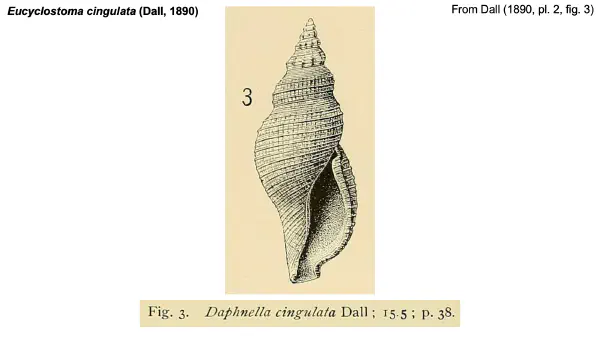
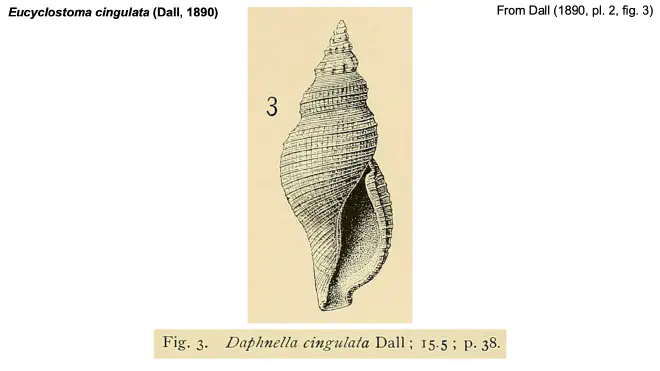
Synonymy: Daphnella cingulata Dall, 1890: p. 38, pl. 2, fig. 3.
Type Specimen: USNM 113176 (holotype), “Shell Creek, De Soto County, Florida” (Merrill, 1905, p. 217).
Other Combinations: Daphnella cingulata Dall, 1890 Eucyclostoma cingulata (Dall, 1890)
Original Description: From Dall, 1890 (p. 38): “Rare in the Caloosahatchie beds and at Shell Creek, Florida. Shell slender, eight or nine-whorled; nucleus small, smooth, three-whorled; subsequent whorls spirally sculptured with larger and smaller squarish elevated threads, which, on the last whorl, tend to be alternately strongand weak; the two series are remarkably uniform among themselves, except that on the periphery two or three of the primary threads will be a little more prominent than the rest, while on the fasciolar region there are five or six uniform large secondary threads, close-set, without any primaries; the transverse sculpture comprises on the earlier whorls eight or ten rounded riblets well defined near the nucleus, but becoming less distinct and finally obsolete on the later whorls; the last whorl and a half has no trace of them; whorls rounded, suture distinct, but not channelled or appressed; incremental lines distinct, slightly elevated, neatly reticulating the secondaries and beading the primaries; aperture elongate, rather narrow, not differentiable from the canal; outer lip smooth within, inner lip with but little callus; notch wide, not very deep, canal hardly indicated. Max. lon. of shell 15.5; max. lat. 6.5 mm. This elegant species is nearest the recent D. limnaiformis Kiener, from which it differs in its stronger sculpture, proportionally longer spire, less reticulated early whorls; fuller and more accentuated whorls, deeper notch and less arcuate columella.”
Online Resources
References
Dall, W. D. 1890. Contributions to the Tertiary Fauna of Florida, with especial reference to the Miocene Silex-Beds of Tampa and the Pliocene beds of the Caloosahatchie River. Part I. Pulmonate, opisthobranchiate and orthodont gastropods. Transactions of the Wagner Free Institute of Science of Philadelphia, 3(1): 1-200, pls. 1-12. BHL
Media
Images
Page History
Page edited by Kelsey K. Engelke. Page reviewed by Jonathan R. Hendricks and first posted April 1, 2026.