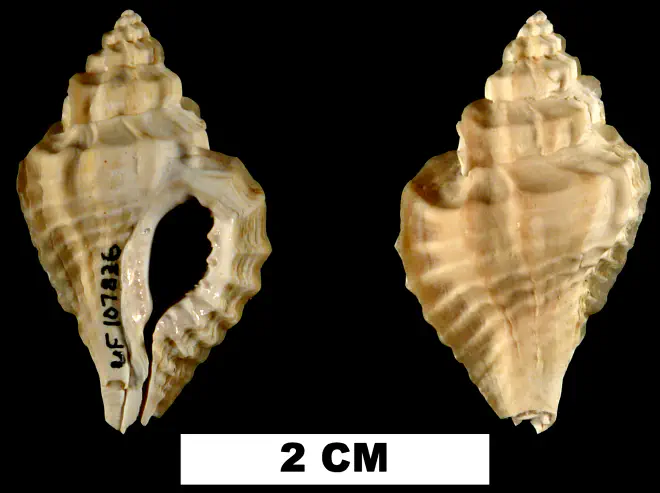
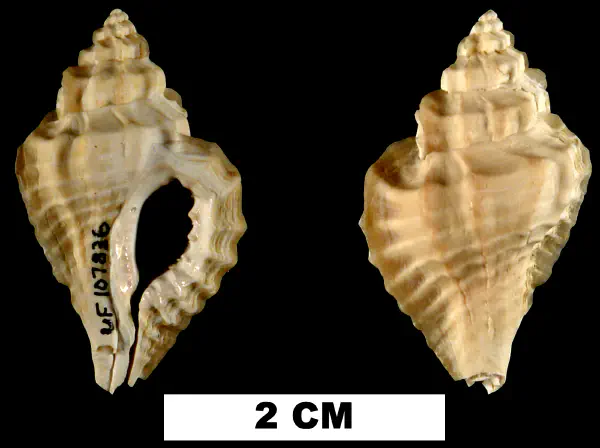
Scientific Classification
| Kingdom: Animalia |
| Phylum: Mollusca |
| Class: Gastropoda |
| Order: Neogastropoda |
| Family: Muricidae |
| Genus: Eupleura |
| Species: Eupleura caudata (Say, 1822) |
Information
Geological Range
Paleogeographic Distribution
Stratigraphic Occurrences
| Flanner Beach Formation [Questionable/rare] |
| Neuse Formation [Questionable/rare] |
| Norfolk Formation [Uncommon] |
| Pamlico Formation [Questionable/rare] |
| Satilla Formation [Questionable/rare] |
| Socastee Formation [Questionable/rare] |
| Bermont Formation [Uncommon] |
| Canepatch Formation [Uncommon] |
| Caloosahatchee Formation [Common] |
| Nashua Formation [Common] |
| Waccamaw Formation [Common] |
| Jackson Bluff Formation [Questionable/rare] |
| Raysor Formation [Questionable/rare] |
| Tamiami Formation (Pinecrest Beds) [Common] |
Remarks
Common name: False oyster drill.
Synonymy: n/a
Type specimen, locality, and stratum: n/a
Other voucher specimens: n/a
Descriptions:
Original Description (from Say, 1822, p. 236-237):
“Shell pale reddish-brown, cancellate with eleven robust costa to the body whirl, and several revolving filiform lines passing over them, which are more prominent upon the varice of the aperture, terminate at its inner edge, and there alternate with the raised lines of the fauces; volutions flattened at their summits, abruptly declining to the suture; canal coarctate, rather longer than the spire: leak rectilinear, reflected at the tip.
Length one inch.
Inhabits the coast of the United States.
Cabinet of the Academy and Philadelphia Museum.
A rather common species.
This generic name I think objectionable, inasmuch as it borders too closely upon Renilla, which designates a genus of the class Polypi of Lamarck. Montfort’s appellation Buffo is not preferable for a similar reason, as it would be liable to be confounded with Bufo, a genus of Reptilia.”
To access this description in its original formatting through the Biodiversity Heritage Library, click here.
Measurements: n/a
Other remarks:
For information on the modern distribution of the species, see Malacolog.
References: n/a
Online resources:
Page history:
Some of the content on this page was originally published on the Neogene Atlas of Ancient Life on July 21, 2014. It was developed by Jonathan R. Hendricks and colleagues and migrated here in 2026.
This page was last modified on October 28, 2026 by Jonathan R. Hendricks.
Media
Images