
Scientific Classification
| Kingdom: Animalia |
| Phylum: Mollusca |
| Class: Gastropoda |
| Order: Neogastropoda |
| Family: Pseudomelatomidae |
| Genus: Monilispira |
| Species: Monilispira bigemma (Dall, 1890) |
Information
Geological Range
Paleogeographic Distribution
Stratigraphic Occurrences
| Caloosahatchee Formation |
| Jackson Bluff Formation |
| Duplin Formation |
| Tamiami Formation (Pinecrest Beds) |
Remarks
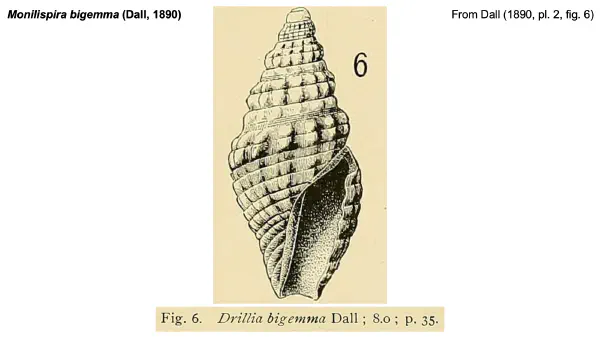
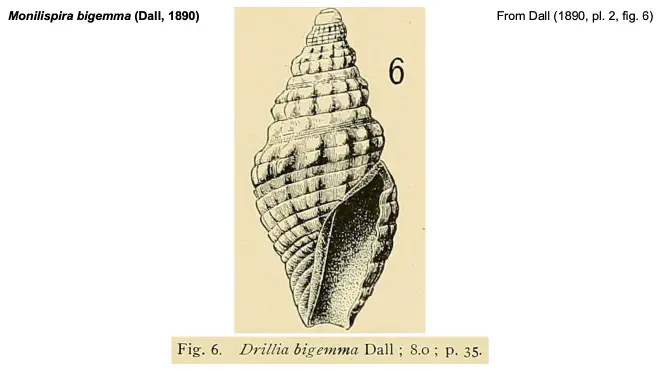
Synonymy: Drillia bigemma Dall, 1890: p. 35, pl. 2, fig. 6.
Type Specimen: USNM 97327 (holotype), “Caloosahatchie River, near Fort Thompson, Florida” (Merrill, 1905, p. 235).
Other Combinations: Drillia bigemma Dall, 1890. Monilispira bigemma (Dall, 1890) (Accepted combination)
Original Description: From Dall, 1890 (p. 35): “Shell small, stout,fusiform, six-whorled; nucleus rather large, at first smooth, then spirally grooved; succeeding whorls rather coarsely sculptured; spiral sculpture of rather sharp grooves, with wide interspaces, cutting the transverse sculpture; on the earlier whorls there isa stout cord next the suture, in front of which the fasciole is somewhat depressed, with three or four fine spirals on it; on the periphery is a deep groove, and next the succeeding suture the whorl is again depressed; on the base of the last whorl in front of the periphery are about six interspaces between grooves, of which the first, third and fourth are depressed below the others; all the others have their posterior edges higher than the anterior edges; beside these there are four or five flattish spirals on the canal; the transverse sculpture is exhibited chiefly in the form of nodes on the spirals. On the periphery, divided by a sharp groove, is a paired series of large, axially oblong nodes; on the basal spirals the nodes are small, squarish and twice as numerous in the same spiral distance; the presutural cord has a series of round nodules which sometimes are obsolete, but when present follow the peripheral nodes; terminal varix not prominent; notch wide and deep; callus moderate; outer lip arcuate in the middle; canal wide, short, straight. Max. lon. of shell 8.0; max. lat. 3.0 mm. This species is rather peculiarly sculptured and I do not recall any recent species resembling it.”
Online Resources
References
Dall, W. D. 1890. Contributions to the Tertiary Fauna of Florida, with especial reference to the Miocene Silex-Beds of Tampa and the Pliocene beds of the Caloosahatchie River. Part I. Pulmonate, opisthobranchiate and orthodont gastropods. Transactions of the Wagner Free Institute of Science of Philadelphia, 3(1): 1-200, pls. 1-12. BHL.
Media
Images
Page History
Page edited by Kelsey K. Engelke. Page reviewed by Jonathan R. Hendricks and first posted April 1, 2026.