Scientific Classification
| Kingdom: Animalia |
| Phylum: Mollusca |
| Class: Gastropoda |
| Order: Littorinimorpha |
| Family: Naticidae |
| Genus: Neverita |
| Species: Neverita duplicata (Say, 1822) |
Information
Geological Range
Paleogeographic Distribution
Stratigraphic Occurrences
| Anastasia Formation [Common] |
| Coffee Mill Hammock Formation [Questionable/rare] |
| Flanner Beach Formation [Uncommon] |
| Fort Thompson Formation [Common] |
| Neuse Formation [Questionable/rare] |
| Norfolk Formation [Uncommon] |
| Pamlico Formation [Questionable/rare] |
| Satilla Formation [Uncommon] |
| Socastee Formation [Questionable/rare] |
| Bermont Formation [Common] |
| Canepatch Formation [Uncommon] |
| Bear Bluff Formation [Questionable/rare] |
| Caloosahatchee Formation [Abundant] |
| Caloosahatchee Formation (Bee Branch Member) |
| Chowan River Formation [Uncommon] |
| Nashua Formation [Common] |
| Waccamaw Formation [Common] |
| Croatan Formation [Uncommon] |
| Duplin Formation [Common] |
| Duplin / Raysor Formations [Questionable/rare] |
| Jackson Bluff Formation [Common] |
| Raysor Formation [Common] |
| Tamiami Formation [Questionable/rare] |
| Tamiami Formation (Pinecrest Beds) [Abundant] |
| Waccamaw Formation (Lower) |
| Yorktown Formation [Common] |
| Yorktown Formation (Moore House Member) |
| St. Marys Formation |
Remarks
Common name: n/a
Synonymy: n/a
Type specimen, locality, and stratum: n/a
Other voucher specimens: n/a
Descriptions:
Original Description (from Say, 1822, p. 247-248):
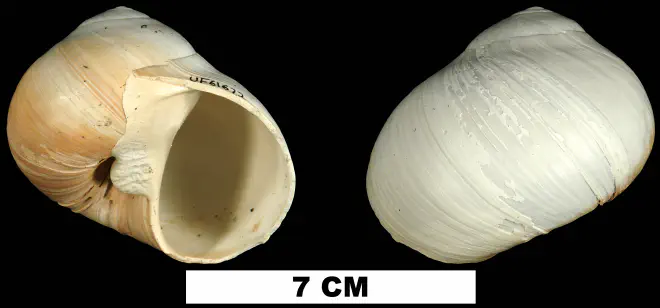
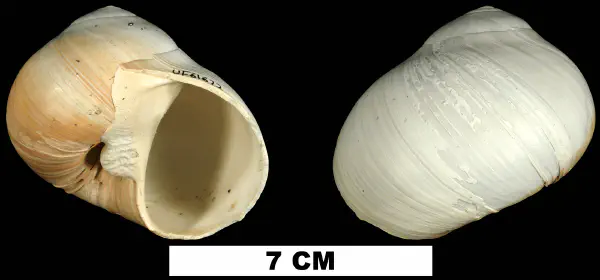
“Shell thick, sub-globose, cinereous, with a black line revolving on the spire above the suture, and becoming gradually diluted, dilated, and obsolete in its course; within brownish livid; a large incrassated callous of the same colour extends beyond the columella, and nearly covers the umbilicus from above; umbilicus with a profound sulcus or duplication.
Greatest length about two inches. Greatest breadth rather more.
Inhabits the coast of the United States.
Cabinet of the Academy and Philadelphia Museum.
Very numerous upon almost the whole extent of our coast. The spire in some specimens is much more elevated than in others, and the duplication within the umbilicus, is sometimes partially concealed by the projecting callous.
In the collection of the Academy of Natural Sciences, is a species from Candia, presented by Mr. S. Hazard, which very much resembles this, but it differs in being destitute of the black line, and in having the umbilicus partially covered from the side, leaving only a linear, semicircular, lateral opening. Another specimen from India strongly resembles it, and is also marked with the black line, but there is only a circumscribed callous extending laterally, leaving a large umbilicus, and marked transversely by a groove.
I formerly referred this species to N. rugosa, but it appears to be a much larger species, as Dillwyn states the rugosa to be only ten lines long. It is probably the same species as that represented by Lister on plates 562 and 563, but I do not find those figures referred to at all by Dillwyn.”
To access this description in its original formatting through the Biodiversity Heritage Library, click here.
Measurements: n/a
Other remarks:
For information on the modern distribution of the species, see Malacolog and WoRMS.
Stratigraphic notes: St. Marys Formation: Age not resolved beyond “Miocene”.
References: n/a
Online resources:
Page history:
Some of the content on this page was originally published on the Neogene Atlas of Ancient Life on August 25, 2015. It was developed by Jonathan R. Hendricks and colleagues and migrated here in 2026.
This page was last modified on October 28, 2026 by Jonathan R. Hendricks.
Media
Images