Scientific Classification
| Kingdom: Animalia |
| Phylum: Mollusca |
| Class: Gastropoda |
| Order: Neogastropoda |
| Family: Nassariidae |
| Genus: Phrontis |
| Species: Phrontis vibex (Say, 1822) |
Information
Geological Range
Paleogeographic Distribution
Stratigraphic Occurrences
| Anastasia Formation [Questionable/rare] |
| Coffee Mill Hammock Formation [Common] |
| Fort Thompson Formation [Common] |
| Neuse Formation [Questionable/rare] |
| Pamlico Formation [Common] |
| Satilla Formation [Questionable/rare] |
| Bermont Formation [Common] |
| Canepatch Formation [Questionable/rare] |
| Caloosahatchee Formation [Abundant] |
| Nashua Formation [Uncommon] |
| Waccamaw Formation [Common] |
| Duplin Formation [Questionable/rare] |
| Guaiguaza Clay |
| Raysor Formation [Questionable/rare] |
| Tamiami Formation (Pinecrest Beds) [Common] |
Remarks
Common name: bruised nassa.
Synonymy:
Synonymous with Nassarius vibex (Say,1822) and Nassa vibex Say, 1822 (original combination).
Type specimen, locality, and stratum: n/a
Other voucher specimens: n/a
Descriptions:
Original Description (from Say, 1822, p. 231):
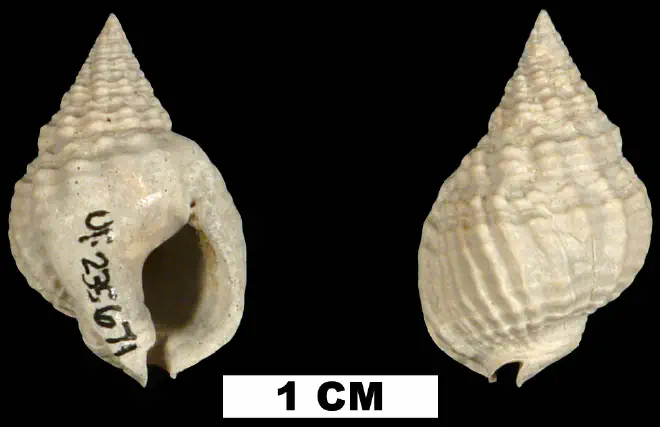
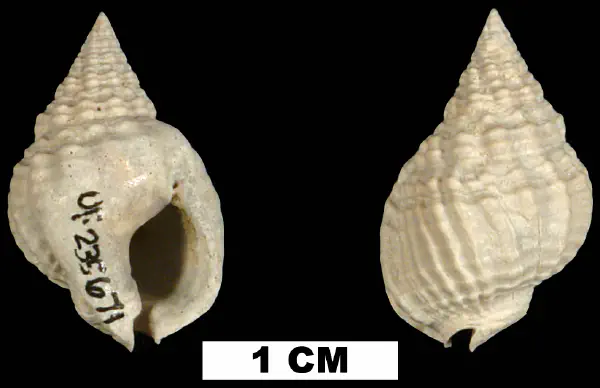
“Shell cancellate, ventricose, cinereous or pale reddish-brown, with two or three irregular, sometimes obsolete darker fascia; body whirl with twelve thick, prominent costa, and about as many revolving filiform lines, which are not much elevated, and but simply crenate the costa and lip; labrum incrassated, with about two more prominent teeth within; labium callous; spire short, rapidly attenuated to an acute tip.
Length three-fifths of an inch.
Inhabits the southern and middle coast.
Cabinet of the Academy and Philadelphia Museum.
Rather rare. I found but four specimens. For the locality of the coast of the middle states, I am indebted to my brother, Mr. B. Say, who brought me a specimen from the shores of New Jersey.”
To access this description in its original formatting through the Biodiversity Heritage Library, click here.
Measurements: n/a
Other remarks:
For information on the modern distribution of the species, see Malacolog and WoRMS.
References: n/a
Online resources:
Page history:
Some of the content on this page was originally published on the Neogene Atlas of Ancient Life on July 9, 2015. It was developed by Jonathan R. Hendricks and colleagues and migrated here in 2026.
This page was last modified on October 28, 2026 by Jonathan R. Hendricks.
Media
Images