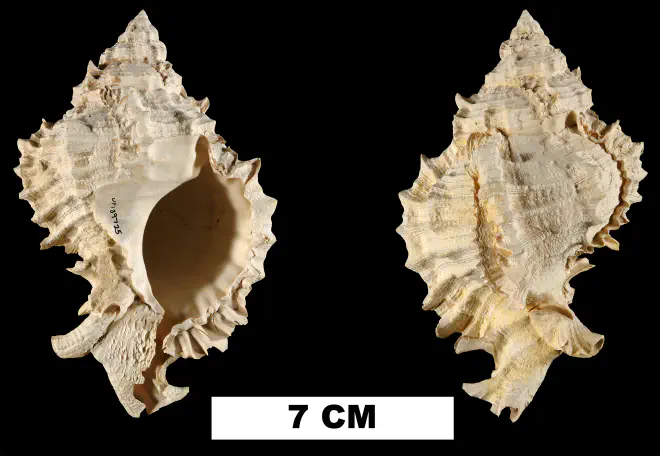
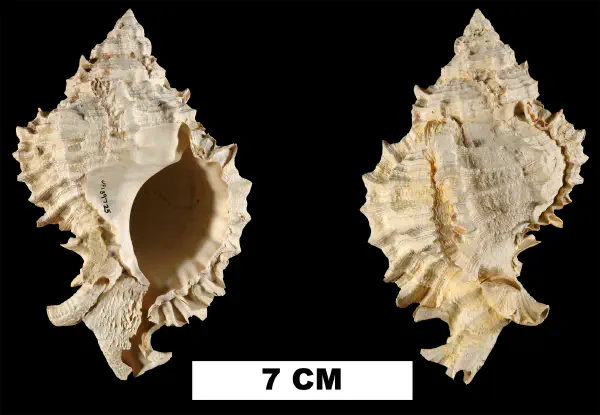
Scientific Classification
| Kingdom: Animalia |
| Phylum: Mollusca |
| Class: Gastropoda |
| Order: Neogastropoda |
| Family: Muricidae |
| Genus: Phyllonotus |
| Species: Phyllonotus pomum (Gmelin, 1791) |
Information
Geological Range
Paleogeographic Distribution
Stratigraphic Occurrences
| Fort Thompson Formation [Questionable/rare] |
| Jaimanitas Formation |
| Bermont Formation [Abundant] |
| Caloosahatchee Formation [Common] |
| Nashua Formation [Uncommon] |
| Mare Formation |
| Tamiami Formation (Pinecrest Beds) [Common] |
Remarks
Common name: Apple murex.
Synonymy:
Synonymous with Murex pomum Gmelin, 1791 (original combination) and Chicoreus pomum.
Type specimen, locality, and stratum: n/a
Other voucher specimens: n/a
Descriptions:
First English Description (from Dall, 1889, p. 198-199):
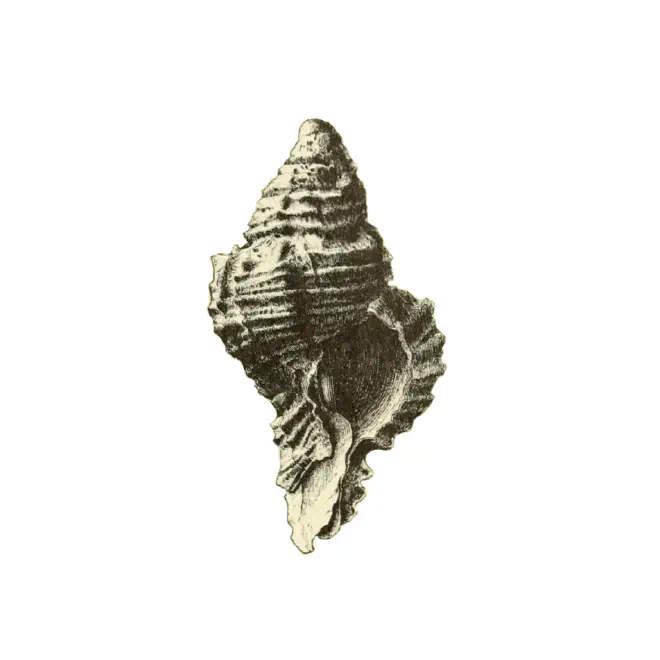
“Habitat. Station 152, Flannegan Passage, in 27 fms., sand, temperature 78° F., one very young specimen, which I have figured.
This species extends its range from the warm water off the coast of North Carolina to Florida, the mainland round to Venezuela, etc., and the Antilles. One of the brightest-colored specimens I have seen came from near Beaufort, N. C. The colors are variable, and I suspect the Murex imperialis from the island of Margarita, West Indies (if not an error for Margarita in the Gulf of California), referred to by Mr. Tryon, is merely a very large, pale, bright-mouthed M. pomum. The typical color of the mouth is pale salmon-color picked out with dark brown, but in some specimens the brown becomes a tolerably lively yellow, and the salmon-color a pale pink, while in still others the mouth is white, especially at inter-varical periods. The number of varices is usually three, but this is not invariable; there may be four, or the number may be irregular. The young shell sometimes looks like a little stumpy Fusus, of a vivid pink. Varices are inconspicuous in the early whorls, which are reticulated, while the nucleus is deep pink, or brown, smooth, small, and about two-whorled. The epidermis of the young shell is quite hispid.”
To access this description in its original formatting through the Biodiversity Heritage Library, click here.
Measurements: n/a
Other remarks:
For information on the modern distribution of the species, see Malacolog.
References: n/a
Online resources:
Page history:
Some of the content on this page was originally published on the Neogene Atlas of Ancient Life on May 3, 2014. It was developed by Jonathan R. Hendricks and colleagues and migrated here in 2026.
This page was last modified on October 28, 2026 by Jonathan R. Hendricks.
Media
Images