Scientific Classification
| Kingdom: Animalia |
| Phylum: Mollusca |
| Class: Gastropoda |
| Order: Neogastropoda |
| Family: Pseudomelatomidae |
| Genus: Strictispira |
| Species: Strictispira ebenina (Dall, 1890) |
Information
Geological Range
Paleogeographic Distribution
Stratigraphic Occurrences
| Caloosahatchee Formation |
| Tamiami Formation (Pinecrest Beds) |
Remarks
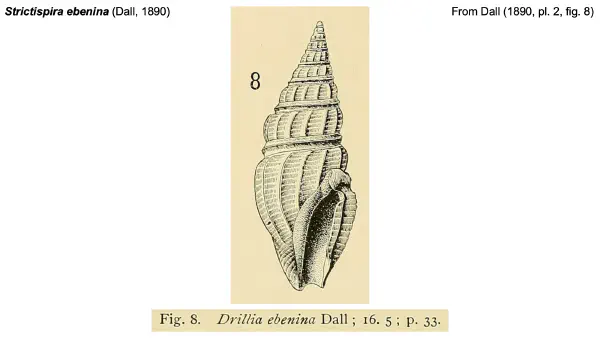
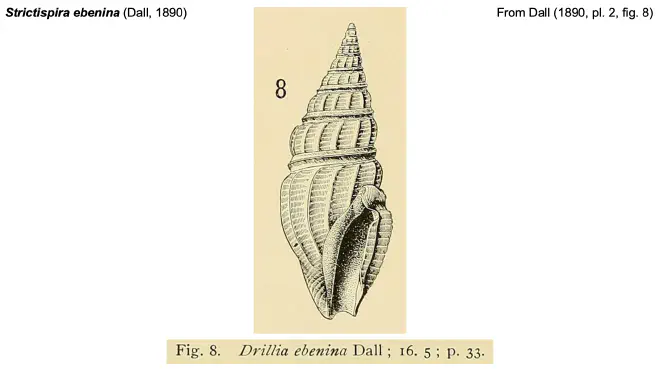
Synonymy: Drillia ebenina Dall, 1890: p. 33, pl. 2, fig. 8.
Type Specimen: USNM 97318 (holotype), “Caloosahatchie River, near Fort Thompson, Florida” (Merrill 1905, p. 235).
Other Combinations: Drillia ebenina Dall, 1890 Glossispira ebenina (Dall, 1890) Clathrodrillia ebenina (Dall, 1890) Strictispira ebenina (Dall, 1890) (Accepted name)
Original Description: From Dall, 1890 (p. 33): “Miocene of Santo Domingo (Gabb); Pliocene of the Caloosahatchie beds. Recent on the shores of the Gulf of Mexico, from Florida to Vera Cruz. Shell stout, fusiform, spire acutely pointed, color (in the recent form) dead black, fading to very dark reddish brown; whorls eleven, of which two belong to the smooth dark brown nucleus, which is minute; last whorl more than half the shell; transverse sculpture (on the last whorl fifteen, beside the varix) sharp, slightly elevated flexuous ribs, with much wider interspaces, abrupt and largest where they begin in front of the fasciole and growing less conspicious to the canal; incremental lines perceptible, but not strong; varix large, rounded, swollen; spiral sculpture of fine, uniform threads, with wider interspaces, becoming coarser on the canal and more close-set toward the suture; these do not cut or nodulate the ribs on the periphery, but are well marked between them; behind the anal fasciole is a sharp, even keel witha space between its edge and the margin of the suture; suture inconspicuous, slightly appressed; aperture short, narrow; throat smooth; canal short, wide; pillar straight, with no umbilical chink and very little callus except opposite the notch; notch circular, subtubular, nearly closed in front, not as wide as the fasciole. Max. lon. of shell 16.5; of aperture 7.0; of last whorl 10.0; max. lat. 6.5 mm. This fine species was first found living in shallow water on the Florida Keys, by H. Hemphill. I find specimens of it together with several other species confused together under the name of Jamaicense Guppy in the Gabb collection at Philadelphia.”
Online Resources
References
Dall, W. D. 1890. Contributions to the Tertiary Fauna of Florida, with especial reference to the Miocene Silex-Beds of Tampa and the Pliocene beds of the Caloosahatchie River. Part I. Pulmonate, opisthobranchiate and orthodont gastropods. Transactions of the Wagner Free Institute of Science of Philadelphia, 3(1): 1-200, pls. 1-12. BHL
Media
Images
Page History
Page edited by Kelsey K. Engelke. Page reviewed by Jonathan R. Hendricks and first posted April 1, 2026.