Scientific Classification
| Kingdom: Animalia |
| Phylum: Mollusca |
| Class: Gastropoda |
| Order: Caenogastropoda incertae sedis |
| Family: Turritellidae |
| Genus: Turritella |
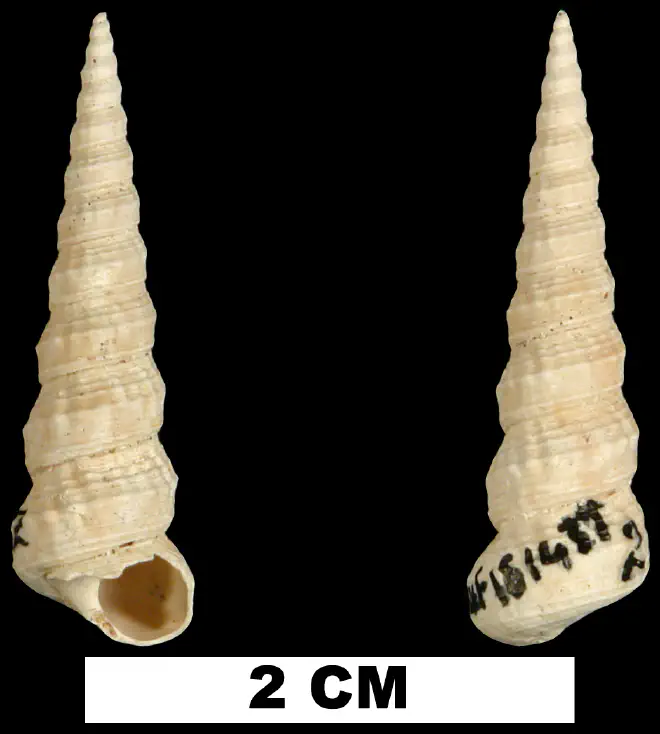
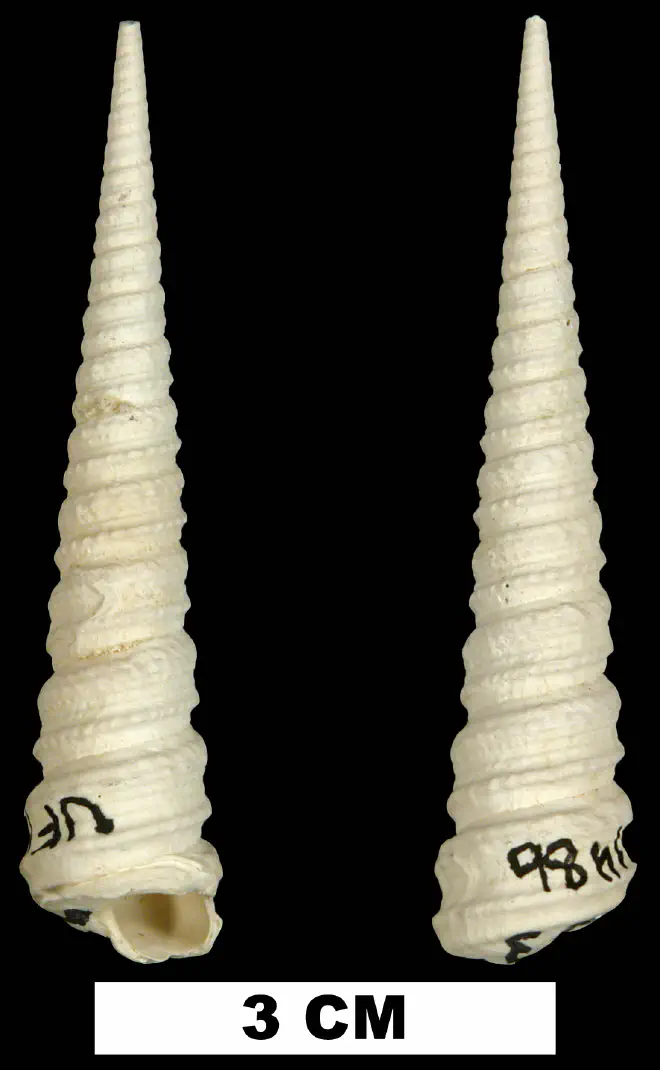
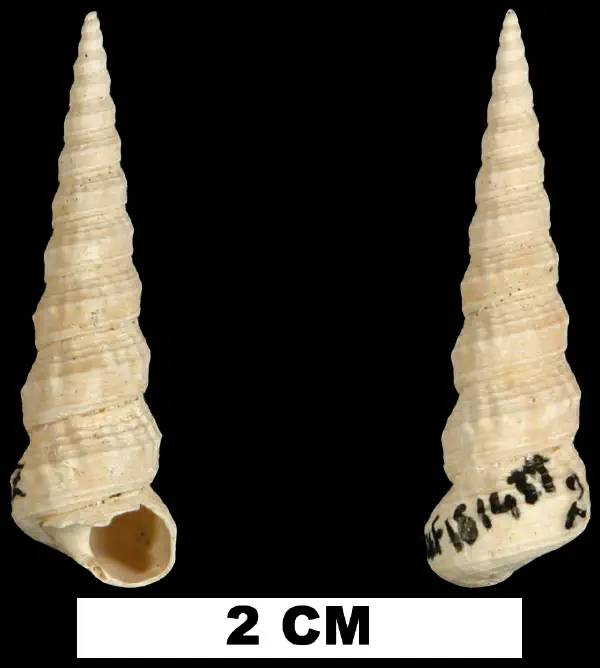
| Species: Turritella perexilis Conrad, 1875 |
Information
Geological Range
Paleogeographic Distribution
Stratigraphic Occurrences
| Coffee Mill Hammock Formation [Questionable/rare] |
| Fort Thompson Formation [Questionable/rare] |
| Bermont Formation [Common] |
| Caloosahatchee Formation [Abundant] |
| Nashua Formation [Uncommon] |
| Waccamaw Formation [Common] |
| Duplin Formation [Questionable/rare] |
| Jackson Bluff Formation [Common] |
| Tamiami Formation [Questionable/rare] |
| Tamiami Formation (Ochopee Limestone) [Questionable/rare] |
| Tamiami Formation (Pinecrest Beds) [Common] |
Remarks
Common name: n/a
Synonymy:
Previously listed as Turritella subannulata and Turritella acropora on the Neogene Atlas of Ancient Life.
Type specimen, locality, and stratum: n/a
Other voucher specimens: n/a
Descriptions:
Original Description (from Heilprin, 1886, p. 89):
“Shell turreted, acuminate; whorls angular, marked by a broad basal impressed band or channel, which is ornamented with numerous delicate revolving lines; surface of the whorls above the channel longitudinally plicated, with two well-defined submedial lines, and numerous finer lines, as in the channel; aperture rounded; base convex.
Length, 1.2 inches; width of base, .25 inch.
Abundant in the banks below Fort Thompson.”
From the former Turritella acropora page:
Original Description (from Dall, 1889, p. 264-265):
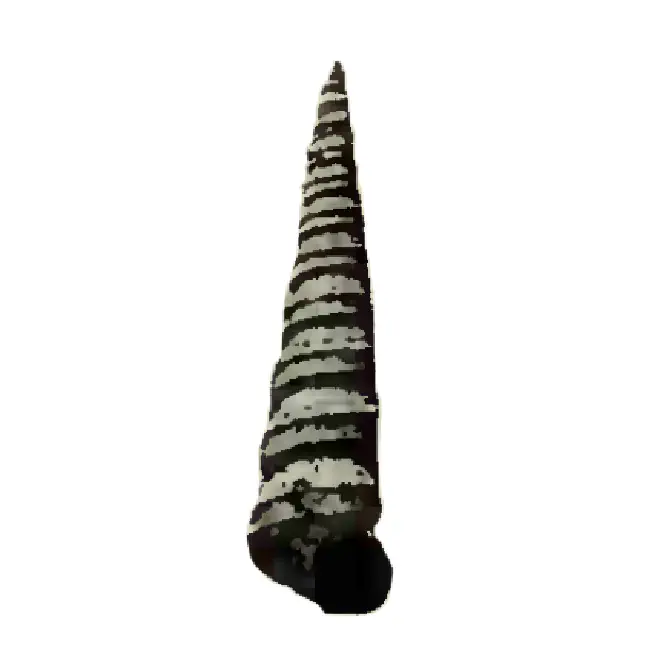
“Nucleus white, polished, loosely coiled, small, with about two very rounded whorls. Shell whitish, violet, or pale rose-color, with longitudinal flammules of dark reddish brown, and light colored primary spiral threads articulated with elongated distant brown spots. Whorls about fifteen, those after the nucleus with a distinct median keel and obscure suture, the later ones with less prominent median or perhaps several indistinct keels; the last two whorls less closely coiled in the adult, showing the posterior edge overhung by the preceding whorl at the suture. Sculpture of primary and secondary spirals very close set, the primaries flatter and polished above; the finer or secondary spirals very fine; both have a tendency to articulation, and the epidermis in the interspaces bridges over fine sharp incremental lines. Irregularities of growth sometimes simulate faint longitudinal waves. Base similarly sculptured, slightly excavated, bordered by a rounded not carinated edge; columella thin, arched; outer lip thin, sinuous, subangulate anteriorly; aperture subquadrate, varying with the sculpture and individual. Max. Ion. of shell, 31.0; max. lat., 8.0 mm.
Habitat. West of Florida, 14-50 fms.; off Cape San Antonio, 413 fms.; off Sombrero, in 54 fms. Coast of North Carolina, near Hatteras, to the Gulf of Mexico, Texas, and Yucatan, and the Antilles, in 3-73 fms., not living deeper than 25 fms., U. S. Fish Commission. Fossil in Florida Pliocene.
This interesting species is variable in color, and also in the form of the whorls. Sometimes the latter are perfectly flat, at other times rounded. The brown flammulae are occasionally absent. The striation appears very fine to the naked eye. It is only under a magnifier that the separation into primary and secondary spirals becomes evident. This fine striation will enable the species to be recognized, whatever its color or form, which last, though variable, is not remarkably so. This shell is sometimes bleached pure white, but I have seen no white specimens which were fresh. It is, not rarely, of a delicate rose or violet tint. That what appears to be so common a shell should have gone unnamed until now would be singular, but it has probably been taken by those who have collected it for the tip of a Vermicularia, or the young of T. imbricata L. Complete and adult specimens are rare, fragments common. I find nothing like it in the monographs.”
To access this description in its original formatting through the Biodiversity Heritage Library, click here.
Measurements: n/a
Other remarks:
From the former Turritella acropora page:
For information on the modern distribution of the species, see Malacolog and WoRMS.
References: n/a
Online resources: n/a
Page history:
Some of the content on this page was originally published on the Neogene Atlas of Ancient Life on August 13, 2015 and August 17, 2015. It was developed by Jonathan R. Hendricks and colleagues and migrated here in 2026.
This page was last modified on October 28, 2026 by Jonathan R. Hendricks.
Media
Images