Scientific Classification
| Kingdom: Animalia |
| Phylum: Mollusca |
| Class: Bivalvia |
| Order: Pectinida |
| Family: Pectinidae |
| Genus: Amusium |
| Species: Amusium mortoni (Ravenel, 1844) |
Information
Geological Range
Paleogeographic Distribution
Stratigraphic Occurrences
| Bermont Formation [Questionable/rare] |
| Canepatch Formation [Questionable/rare] |
| Bear Bluff Formation [Questionable/rare] |
| Caloosahatchee Formation [Common] |
| Nashua Formation [Common] |
| Waccamaw Formation [Common] |
| Duplin / Raysor Formations [Uncommon] |
| Jackson Bluff Formation [Common] |
| Raysor Formation [Uncommon] |
| Tamiami Formation [Common] |
| Tamiami Formation (Lower) [Questionable/rare] |
| Tamiami Formation (Ochopee Limestone) [Uncommon] |
| Tamiami Formation (Pinecrest Beds) [Common] |
| Yorktown Formation [Uncommon] |
| Goose Creek Formation [Common] |
Remarks
Common name: n/a
Synonymy: n/a
Type specimen, locality, and stratum: n/a
Other voucher specimens: n/a
Descriptions:
Original Description (from Ravenel, 1844, p. 96):
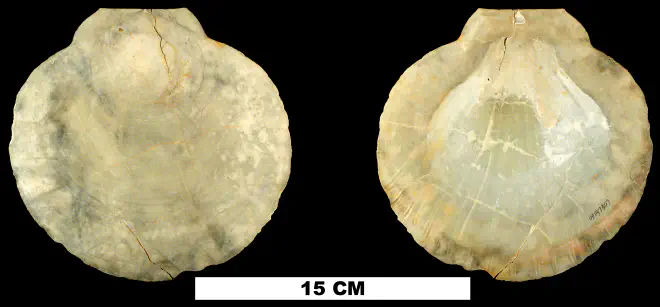
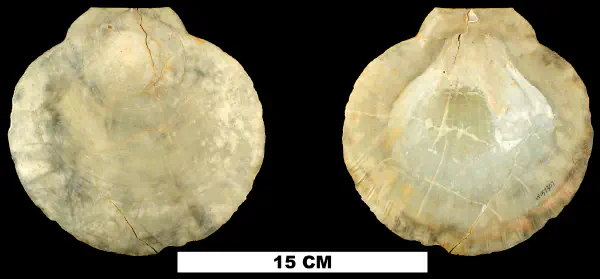
“Specific character—Orbicular, thin, both valves moderately convex, one more so than the other—outside, with numerous concentric obsolete striae; inside,—with from eighteen to twenty four radiating double ribs, slightly elevated; ears large, sub-equal, striated externally.
This species is nearly allied to the P. pleuronectus and P. japonicus. It is found in the limestone on my plantation, The Grove, in St. Thomas’s Parish, about 17 miles from Charleston, and also on Goose creek, at Mr. Henry Smith’s, about 7 miles South West from the Grove deposit, and 11 miles from Charleston; Cooper River being between these localities.
This shell is abundant at the Grove, but being large and thin, it is generally broken in getting out the marl, and with the exception of a few small specimens, I have not been able to procure a perfect valve.
The largest specimen in my possession although not perfect, is sufficiently so to determine its size; it is 8.75 inches in diameter.
I take much pleasure in designating this shell by the name of our distinguished Geologist, Dr. Samuel George Morton, of Philadelphia.”
To access this description in its original formatting through the Biodiversity Heritage Library, click here.
Measurements: n/a
Other remarks: n/a
References: n/a
Online resources: n/a
Page history:
Some of the content on this page was originally published on the Neogene Atlas of Ancient Life on August 26, 2014. It was developed by Jonathan R. Hendricks and colleagues and migrated here in 2026.
This page was last modified on October 28, 2026 by Jonathan R. Hendricks.
Media
Images