Scientific Classification
| Kingdom: Animalia |
| Phylum: Mollusca |
| Class: Bivalvia |
| Order: Arcida |
| Family: Arcidae |
| Genus: Anadara |
| Species: Anadara callicestosa (Dall, 1898) |
Information
Geological Range
Paleogeographic Distribution
Stratigraphic Occurrences
| Waccamaw Formation |
| Tamiami Formation (Pinecrest Beds) |
| Duplin Formation |
| Jackson Bluff Formation |
| Yorktown Formation |
References
Dall, W. D. 1898. Contributions to the Tertiary fauna of Florida with especial reference to the Silex Beds of Tampa and the Pliocene beds of the Caloosahatchie River including in many cases a complete revision of the generic groups treated of and their American Tertiary species. Part IV. I. Prionodesmacea: Nucula to Julia. II. Teleodesmacea: Teredo to Ervilia. Transactions of the Wagner Free Institute of Science of Philadelphia, 3(4): i-viii, pp. 571-947, pls. 13-35.
Remarks
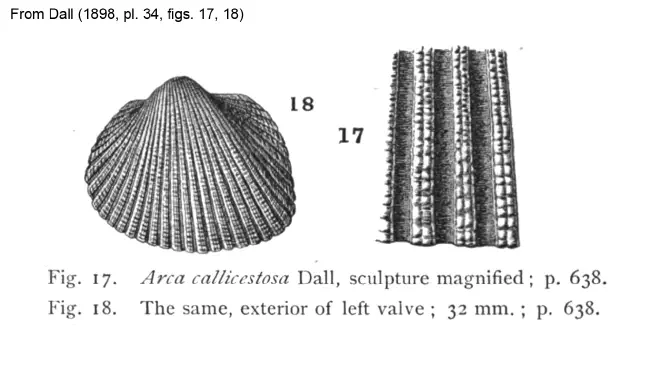
Original Combination: Arca callicestosa Dall, 1898.
Original Description:
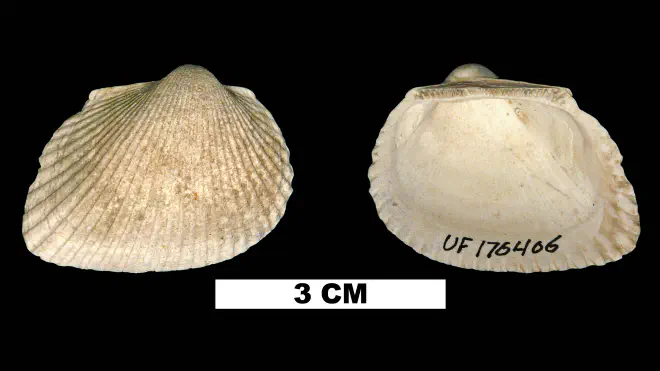
From Dall (1898, pp. 638, 639): “Upper bed (Miocene) at Gaskin’s Wharf, on the Nansemond River, sixteen miles below Suffolk, Virginia; F. Burns. Shell of moderate size, rather thin, rhomboidal, with small, prominent, mediosulcate, prosocoelous beaks situated at about the anterior third of its length; left valve with about thirty-seven squarish subequal radial ribs, separated by narrower channelled interspaces; on the tops of these ribs are four longitudinal threads, the inner pair larger and more prominent but separated by a somewhat deeper sulcus than those external to the inner threads; concentric sculpture of fine, close, rounded, slightly elevated threads, which overrun the whole shell, ribs, and interspaces, and at short intervals, at the intersection with the inner pair of rib-threads, they become minutely nodulous, while the reticulations have a punctate appearance, giving a surface somewhat like fine lace and peculiar, as far as observed, to this species; cardinal area short, rather narrow, with sharply elevated boundaries and a single incised set of grooves forming a lozenge-shaped figure anteriorly; hinge-line short, teeth in two adjacent series, anterior with fifteen, posterior with twenty-six or twenty-seven teeth set vertically, a little oblique at the distal ends of the series; each individual tooth more or less grooved or striate in the direction of motion, as in some recent species; anterior end of shell produced, rounded; posterior end subtruncate, base slightly arched; inner margin of the valves with rather long, deep flutings, corresponding to the external ribs. Lon. 32, alt. 27, diam. 20 mm. (twice the diameter of the single valve). A single valve of this very elegant species was obtained by Mr. Burns. Its sculpture differentiates it from all our other Tertiary species. Arca callipleura Conrad, in which the ribs have a minute nodular sculpture, has the radial threading predominant, while in this species the concentric threads overrun all the rest. The two species are entirely distinct otherwise.”
Online Resources
Media
Images