Scientific Classification
| Kingdom: Animalia |
| Phylum: Mollusca |
| Class: Bivalvia |
| Order: Arcida |
| Family: Arcidae |
| Genus: Barbatia |
| Species: Barbatia caloosahatchiensis (Sheldon, 1916) |
Information
Geological Range
Paleogeographic Distribution
Stratigraphic Occurrences
| Tamiami Formation (Pinecrest Beds) [Common] |
| Caloosahatchee Formation [Common] |
| Tamiami Formation (Murdock Station Member) [Questionable/rare] |
| Arcadia Formation (Tampa Member) |
Remarks
Common name: n/a
Synonymy:
Previously listed as Barbatia irregularis on the Neogene Atlas of Ancient Life.
Type specimen, locality, and stratum: n/a
Other voucher specimens: n/a
Descriptions:
Original Description (from Sheldon, 1916, p. 17-18):
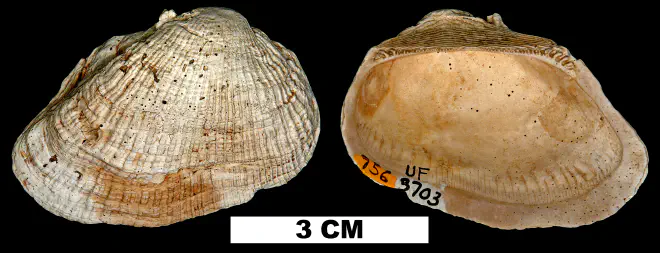
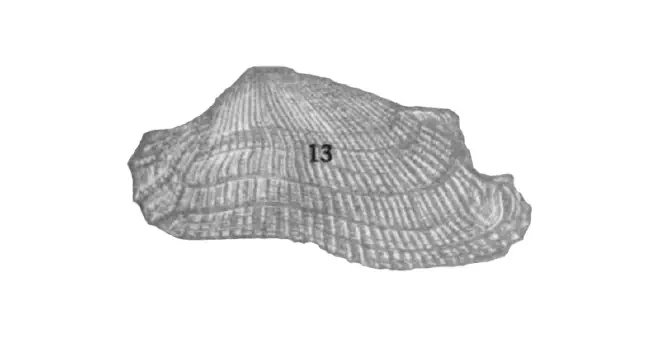
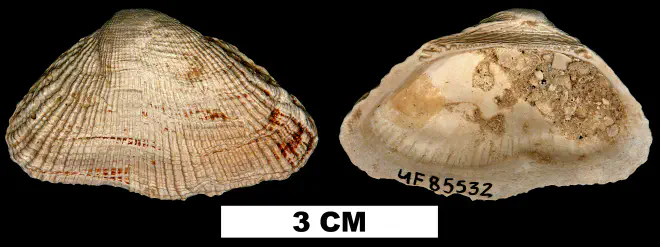
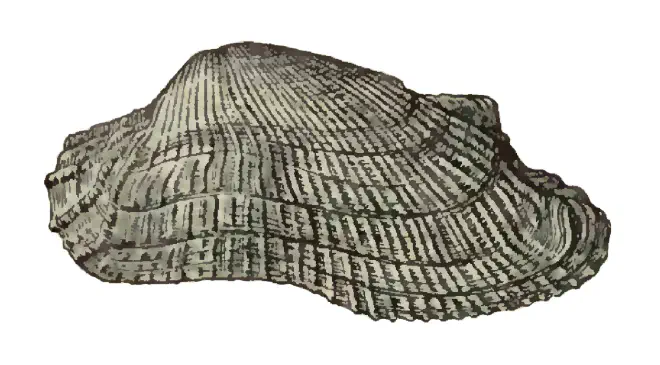
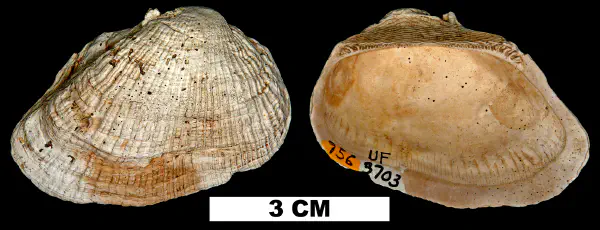
“Shell thin, elongate, irregularly distorted; beaks prosogyrate; at the anterior third rather low and compressed; cardinal area long, rather narrow, with very numerous (twelve) concentric grooves; surface irregular, sculptured with numerous fine radiating, somewhat imbricated ribs, of which those in front of the beaks and on the posterior dorsal slope tend to be larger and more elevated; there is a tendency to alternate or pair among the ribs in some specimens; the imbrications or nodules on the ribs are somewhat regularly spaced and correspond to elevated concentric lines in harmony with the lines of growth; the posterior dorsal slope is bounded by rounded ridges radiating from the beaks; the posterior cardinal margin is elevated and angular with more or less of a depression between it and the radial ridge on each side; the byssal foramen is wide and irregular; the hinge-line is long and straight; the teeth, vertical and very small medially, are sometimes obsolete in the middle of the hinge; distally they become rather distant and quite oblique, as well as larger; the internal margin, though irregular, is not fluted. Lon. of adult 51, alt. 25, diameter 20 mm.
‘This species is distinguished from B. marylandica by its smaller altitude, its coarser and more prominent sculpture, and more irregular hinge; the beaks are also more anterior.’ - Dall, 1898.
Occurrence. – Oligocene of the silex beds at Ballast Point, Tampa Bay (fragment)? Pliocene marls of Shell Creek, Alligator Creek, and the Caloosahatchie. - Dall.”
To access this description in its original formatting through Google Books, click here.
From the former Barbatia irregularis page:
Original Description (from Dall, 1898, p. 623-624):
“Oligocene of the silex beds at Ballast Point, Tampa Bay (fragment)? Pliocene marls of Shell Creek, Alligator Creek, and the Caloosahatchie; Dall and Willcox.
Shell thin, elongate, irregularly distorted; beaks prosogyrate; at the anterior third rather low and compressed; cardinal area long, rather narrow, with very numerous (twelve) concentric grooves; surface irregular, sculptured with numerous fine radiating, somewhat imbricated ribs, of which those in front of the beaks and on the posterior dorsal slope tend to be larger and more elevated; there is a tendency to alternate or pair among the ribs in some specimens; the imbrications or nodules on the ribs are somewhat regularly spaced and correspond to elevated concentric lines in harmony with the lines of growth; the posterior dorsal slope is bounded by rounded ridges radiating from the beaks; the posterior cardinal margin is elevated and angular with more or less of a depression between it and the radial ridge on each side; the byssal foramen is wide and irregular; the hinge-line is long and straight; the teeth, vertical and very small medially, are sometimes obsolete in the middle of the hinge; distally they become rather distant and quite oblique, as well as larger; the internal margin, though irregular, is not fluted. Lon. of adult 51, alt. 25, diameter 20 mm.
This species is distinguished from B. marylandica by its smaller altitude, its coarser and more prominent sculpture, and more irregular hinge; the beaks are also more anterior.”
To access this description in its original formatting through the Biodiversity Heritage Library, click here.
Measurements: n/a
Other remarks:
Stratigraphic notes: Arcadia Formation (Tampa Member): Fm. extends into upper Oligocene.
References: n/a
Online resources:
Page history:
Some of the content on this page was originally published on the Neogene Atlas of Ancient Life on July 17, 2014. It was developed by Jonathan R. Hendricks and colleagues and migrated here in 2026.
This page was last modified on October 28, 2026 by Jonathan R. Hendricks.
Media
Images