Scientific Classification
| Kingdom: Animalia |
| Phylum: Mollusca |
| Class: Bivalvia |
| Order: Arcida |
| Family: Glycymerididae |
| Genus: Costaglycymeris |
| Species: Costaglycymeris subovata (Say, 1824) |
Information
Geological Range
Paleogeographic Distribution
Stratigraphic Occurrences
| Bear Bluff Formation [Questionable/rare] |
| Caloosahatchee Formation [Uncommon] |
| Chowan River Formation [Common] |
| Waccamaw Formation [Uncommon] |
| Croatan Formation [Questionable/rare] |
| Duplin Formation [Common] |
| Duplin / Raysor Formations [Common] |
| Jackson Bluff Formation [Common] |
| Raysor Formation [Common] |
| Tamiami Formation [Questionable/rare] |
| Tamiami Formation (Ochopee Limestone) [Questionable/rare] |
| Tamiami Formation (Pinecrest Beds) [Common] |
| Yorktown Formation [Abundant] |
| Goose Creek Formation [Common] |
| St. Marys Formation |
| Chipola Formation |
Remarks
Common name: n/a
Synonymy: n/a
Type specimen, locality, and stratum: n/a
Other voucher specimens: n/a
Descriptions:
Original Description (from Say, 1824, p. 140):
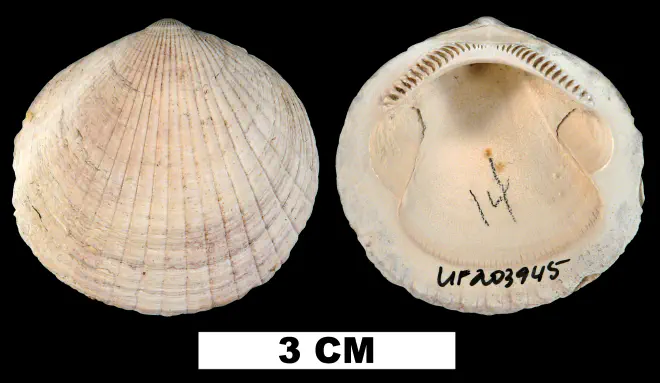
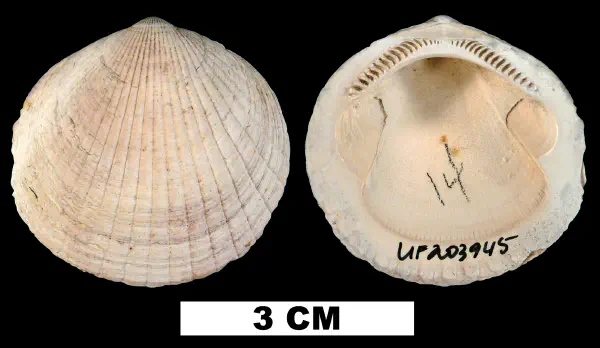
“Longitudinally short ovate, with about thirty longitudinal impressed acute lines, the intervals a little convex.
Description. Shell increasing in width by a slightly curved line from the apex to beyond the middle: lateral curvatures equal: apices separate, small, central; intervening space with but little obliquity to the plane of the shell, with obsolete angulated lines: teeth forming a regularly and much arcuated series, which is rectilinearly truncated above so as to leave in that part a mere edentulous elevated line: within destitute of striae: margin with elevated angular lines: exterior surface with about thirty longitudinal, impressed, acute lines, the intervals a little convex.
Length from the apex to the base one inch and thirteen-twentieths, breadth one inch and a half nearly.
The character of the interval between the beaks is not unlike that of a Cucullaea, but the arrangement of the teeth does not correspond with the definition of that genus.
This shell varies a little in form, being sometimes nearly orbicular.”
To access this description in its original formatting through the Biodiversity Heritage Library, click here.
Measurements: n/a
Other remarks:
Stratigraphic notes: St. Marys Formation: Age not resolved beyond “Miocene”.
References: n/a
Online resources:
Page history:
Some of the content on this page was originally published on the Neogene Atlas of Ancient Life on August 6, 2014. It was developed by Jonathan R. Hendricks and colleagues and migrated here in 2026.
This page was last modified on October 28, 2026 by Jonathan R. Hendricks.
Media
Images