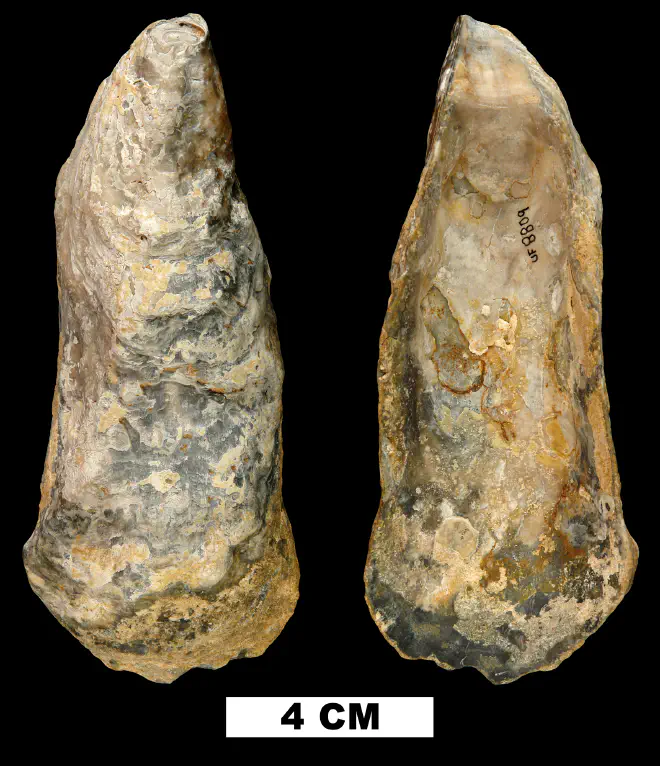
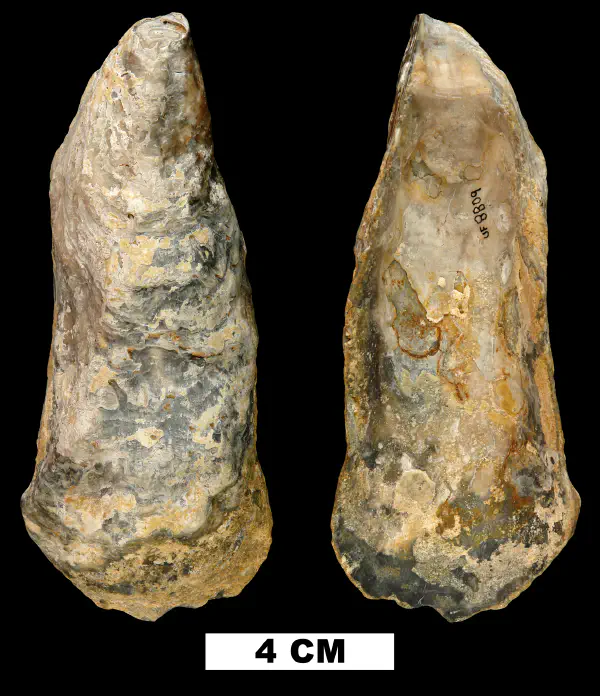
Scientific Classification
| Kingdom: Animalia |
| Phylum: Mollusca |
| Class: Bivalvia |
| Order: Ostreida |
| Family: Ostreidae |
| Genus: Crassostrea |
| Species: Crassostrea normalis (Dall, 1898) |
Information
Geological Range
Paleogeographic Distribution
Stratigraphic Occurrences
| Chipola Formation |
| Parachucla Formation |
| Penney Farms Formation |
Remarks
Common name: n/a
Synonymy: n/a
Type specimen, locality, and stratum: n/a
Other voucher specimens: n/a
Descriptions:
Original Description (from Dall, 1898, p. 684-685):
“Oligocene of Shell Bluff, Savannah River, Georgia; of Martin Station, Florida; White Sulphur Spring, Suwanee River, Hamilton County, Florida; six miles southwest of Gainesville, Alachua County, Florida; La Penotiere’s hammock, near Orient, Tampa, Florida; [EDITED - see note below*], Newnansville; Devil’s Millhopper, near Hawthorne; Sullivan’s old field, Levy County; Johnson’s Sink, Levy County; Magg’s Springs, Alachua County; silex beds of Ballast Point, Tampa Bay; Rock Bluff, Appalachicola River, Calhoun County; red clay (so called Lafayette formation) over the Oak Grove marl, Santa Rosa County, Florida, and lower bed at House Creek, Georgia.
Lower Miocene marl of Shiloh and Jericho, Cumberland County, New Jersey, and near Wilmington, North Carolina; Miocene of California and New Mexico.
It is not unlikely that to the above synonymy should be added O. veleniana Conrad (a typographical error for heleniana) of the Mexican Boundary Report, 1857, and the unrecognizable O. panzana and O. robusta Conrad, 1857.
The O. Tryoni Gabb (1881), from the Miocene of Costa Rica, appears to be a well-characterized species.
The young O. georgiana Conrad is the characteristic fossil of the Upper Oligocene of the Gulf States often found in northern Florida scattered over the surface of the Vicksburg limestone from which the Upper Oligocene marl has been dissolved away. It is the ’leit fossil’ of the Grand Gulf beds, though not confined to them, and occurs in the single meagerly fossiliferous bed below the Altamaha grits. The specimens are usually in poor condition superficially, having the exterior and often the interior vermiculately eroded. It occurs but rarely in the true Miocene, where it seems to become modified into the early type of O. virginica, which is not improbably its direct descendant. In old Post-Pliocene beds or oyster reefs it is not uncommon to find enormously thickened senile specimens of O. virginica which present many of the features of the Oligocene O. georgiana.”
To access this description in its original formatting through Google Books, click here.
Measurements: n/a
Other remarks:
- Note: Dall’s original description reported this taxon from an offensively-named fossil locality near Newnansville, FL. While this locality name has been removed here, the reader may access Dall’s description by clicking the link above.
References: n/a
Online resources: n/a
Page history:
Some of the content on this page was originally published on the Neogene Atlas of Ancient Life on August 7, 2014. It was developed by Jonathan R. Hendricks and colleagues and migrated here in 2026.
This page was last modified on October 28, 2026 by Jonathan R. Hendricks.
Media
Images