Scientific Classification
| Kingdom: Animalia |
| Phylum: Mollusca |
| Class: Bivalvia |
| Order: Cardiida |
| Family: Semelidae |
| Genus: Cumingia |
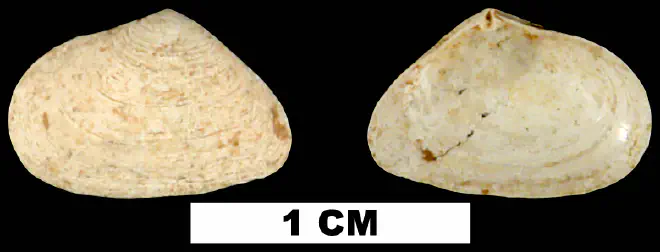
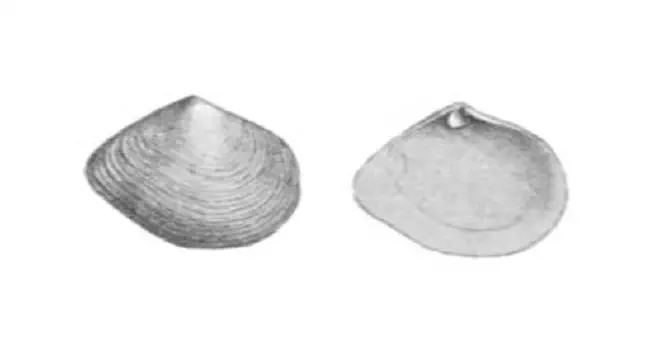
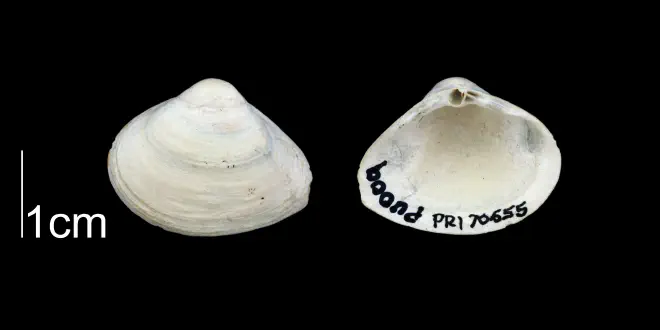
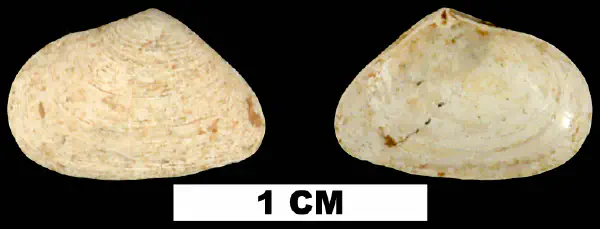
| Species: Cumingia sinuosa Adams, 1850 |
Information
Geological Range
Paleogeographic Distribution
Stratigraphic Occurrences
| Fort Thompson Formation [Questionable/rare] |
| Pamlico Formation [Questionable/rare] |
| Bermont Formation [Common] |
| Canepatch Formation [Questionable/rare] |
| James City Formation [Uncommon] |
| Waccamaw Formation [Uncommon] |
| Duplin Formation [Questionable/rare] |
| Jaimanitas Formation |
| Nashua Formation [Questionable/rare] |
| Tamiami Formation (Pinecrest Beds) [Questionable/rare] |
Remarks
Common name: Tellin semele.
Synonymy:
Previously listed as Cumingia tellinoides and Cumingia vanhyningi on the Neogene Atlas of Ancient Life.
Type specimen, locality, and stratum: n/a
Other voucher specimens: n/a
Descriptions:
Original Description (from Conrad, 1838, p. 28-29):
“Shell ovate-trigonal, thin, with numerous prominent concentric wrinkled striae; anterior side ventricose; the posterior side contracted, subcuneiform; the base near the extremity slightly emarginate; cardinal fosset large; lateral teeth very prominent.
[…] Locality. James river, near Smithfield, Virginia.
Observations. I found a specimen of this shell between the laminae of the Chama corticosa, where it had evidently resided when living. Like the Saxicavae, and other lithophagous bivalves, it is irregular and variable in outline. In a recent state this species inhabits the coast of Rhode Island, and has been found as far south as Florida, but is very rare on the immediate coasts. I obtained a single valve on the beach of Sullivan’s Island, near Charleston, South Carolina.”
To access this description in its original formatting through Google Books, click here.
Measurements: n/a
Other remarks:
For information on the modern distribution of the species, see Malacolog and WoRMS.
References: n/a
Online resources:
Page history:
Some of the content on this page was originally published on the Neogene Atlas of Ancient Life on September 9, 2015 and May 17, 2018. It was developed by Jonathan R. Hendricks and colleagues and migrated here in 2026.
This page was last modified on October 28, 2026 by Jonathan R. Hendricks.
Media
Images