Scientific Classification
| Kingdom: Animalia |
| Phylum: Mollusca |
| Class: Bivalvia |
| Order: Carditida |
| Family: Crassatellidae |
| Genus: Kalolophus |
| Species: Kalolophus speciosus (Adams, 1854) |
Information
Geological Range
Paleogeographic Distribution
Stratigraphic Occurrences
| Coffee Mill Hammock Formation [Uncommon] |
| Fort Thompson Formation [Uncommon] |
| Bermont Formation [Common] |
| Bear Bluff Formation [Questionable/rare] |
| Caloosahatchee Formation [Common] |
| Nashua Formation [Uncommon] |
| Waccamaw Formation [Common] |
| Duplin Formation [Uncommon] |
| Duplin / Raysor Formations [Common] |
| Jackson Bluff Formation [Common] |
| Raysor Formation [Common] |
| Tamiami Formation [Questionable/rare] |
| Tamiami Formation (Murdock Station Member) [Questionable/rare] |
| Tamiami Formation (Lower) [Uncommon] |
| Tamiami Formation (Pinecrest Beds) [Abundant] |
Remarks
Common name: Gibbs’ clam.
Synonymy:
Previously listed as Eucrassatella speciosa on the Neogene Atlas of Ancient Life.
Type specimen, locality, and stratum: n/a
Other voucher specimens: n/a
Descriptions:
First English Description (from Tuomey and Holmes, 1856, p. 74):
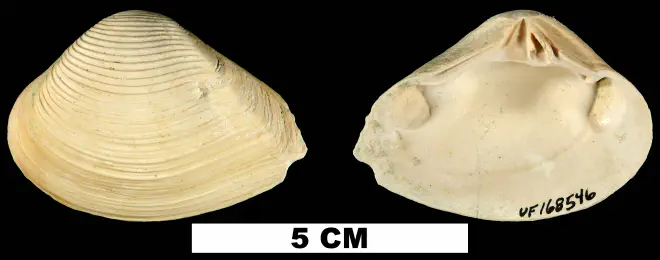
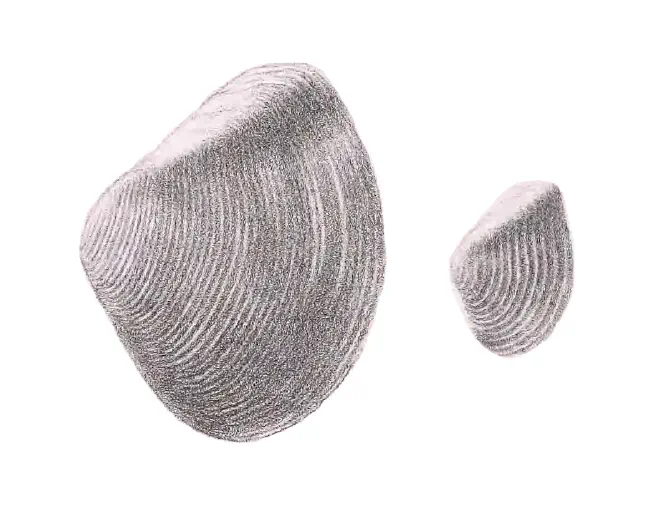
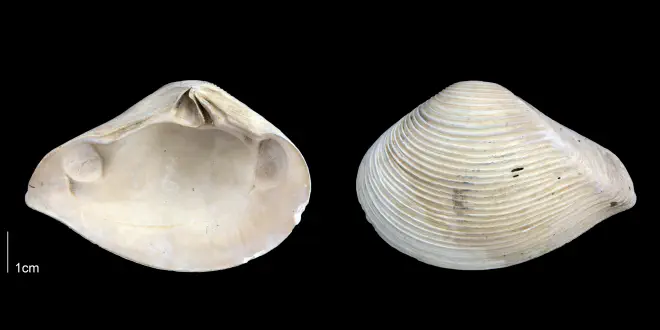
“Description. Shell somewhat triangular, thick, concentrically furrowed; buccal side rounded; anal side somewhat beaked, angular, with a longitudinal ridge; umbones incurved; lunule somewhat excavated. This well-defined species is easily distinguished from any of the varieties of the preceding species. The umbones are much incurved and more inflated than in any form of C. undulata. It differs from the Virginia and Maryland species in its more symetrical form and greater regularity of the sulci, which mark the entire surface of the shell. The ridge on the anal side is prominent, and produces an undulation which extends to the centre of the shell.
The species is very constant in its characters in every stage of growth. Fig. 10 represents a young shell.
We have great pleasure in inscribing this species to our friend and co-laborer, Professor L. R. Gibbes, of the College of Charleston.
Plate XX. Fig. 9, Exterior of left valve.
" 10, Young shell.
To access this description in its original formatting through the Biodiversity Heritage Library, click here.
Measurements: n/a
Other remarks:
For information on the modern distribution of the species, see Malacolog and WoRMS.
Locality. Waccamaw.
Museum, College of Charleston.
The living species of Crassatella are inhabitants of warm climates. The genus is first found in the Cretaceous system, and has its greatest development in the Tertiary.”
References: n/a
Online resources: n/a
Page history:
Some of the content on this page was originally published on the Neogene Atlas of Ancient Life on August 21, 2015. It was developed by Jonathan R. Hendricks and colleagues and migrated here in 2026.
This page was last modified on October 28, 2026 by Jonathan R. Hendricks.
Media
Images