Scientific Classification
| Kingdom: Animalia |
| Phylum: Mollusca |
| Class: Bivalvia |
| Order: Venerida |
| Family: Veneridae |
| Genus: Mercenaria |
| Species: Mercenaria campechiensis (Gmelin, 1791) |
Information
Geological Range
Paleogeographic Distribution
Stratigraphic Occurrences
| Anastasia Formation [Common] |
| Coffee Mill Hammock Formation [Common] |
| Flanner Beach Formation [Uncommon] |
| Fort Thompson Formation [Abundant] |
| Pamlico Formation [Questionable/rare] |
| Satilla Formation |
| Socastee Formation [Questionable/rare] |
| Bermont Formation [Abundant] |
| Canepatch Formation [Uncommon] |
| Bear Bluff Formation [Questionable/rare] |
| Caloosahatchee Formation [Abundant] |
| James City Formation [Uncommon] |
| Nashua Formation [Common] |
| Waccamaw Formation [Common] |
| Croatan Formation [Uncommon] |
| Duplin Formation [Common] |
| Duplin / Raysor Formations [Uncommon] |
| Jackson Bluff Formation [Common] |
| Raysor Formation [Common] |
| Tamiami Formation (Murdock Station Member) [Questionable/rare] |
| Tamiami Formation (Lower) [Common] |
| Tamiami Formation (Ochopee Limestone) [Questionable/rare] |
| Tamiami Formation (Pinecrest Beds) [Abundant] |
| Yorktown Formation [Common] |
| Calvert Formation |
Remarks
Common name: Southern quahog.
Synonymy: n/a
Type specimen, locality, and stratum: n/a
Other voucher specimens: n/a
Descriptions:
First English Description (from Conrad, 1837, p. 251-252):
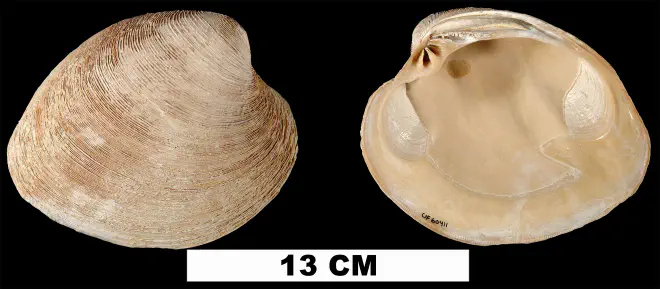
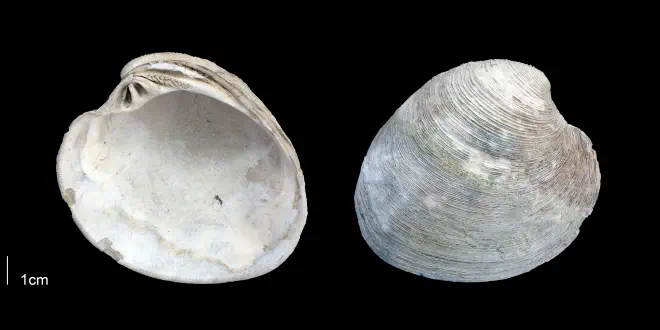
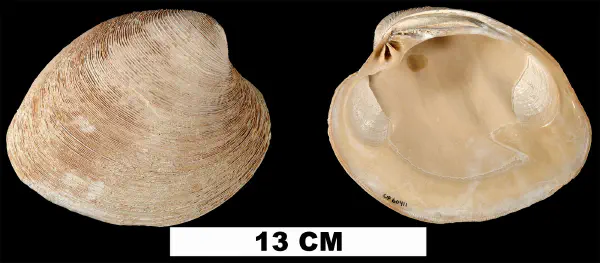
“Shell cordate, inflated, thick and ponderous, with prominent, recurved concentric laminae, more elevated on the anterior and posterior margins; ligament margin arcuate; umbones prominent; lunule large, cordate, defined by a deep groove; posterior extremity slightly emarginate; cavity of the cartilage profound; teeth large, prominent, grooved; muscular impressions very large; inner margin regularly crenulated.
Inhabits Charleston harbor, South Carolina.
This large Venus occurs abundantly in the newer pliocene, on the plantation of Mr. Benners, in Craven County, North Carolina, and many specimens may be collected on the margin of the Neuse, where they have been cast by the waves. The only recent specimen I have seen, was obtained in Charleston harbor, and is now in the collection of the Academy of Natural Sciences. It is a much larger species than the Venus mercenaria, is proportionally shorter, and may be distinguished in every stage of growth by the prominent laminae covering the whole disk, which, when worn, presents a ribbed or sulcated surface. The largest I have seen is in possession of H. B. Croom, Esq., and measures about six inches in length.
It is named in compliment to Dr. S. G. Morton.”
To access this description in its original formatting through Google Books, click here.
Measurements: n/a
Other remarks:
For information on the modern distribution of the species, see Malacolog.
References: n/a
Online resources: n/a
Page history:
Some of the content on this page was originally published on the Neogene Atlas of Ancient Life on July 11, 2014. It was developed by Jonathan R. Hendricks and colleagues and migrated here in 2026.
This page was last modified on October 28, 2026 by Jonathan R. Hendricks.
Media
Images