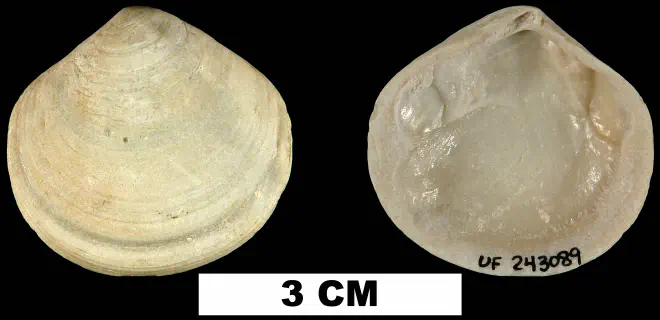
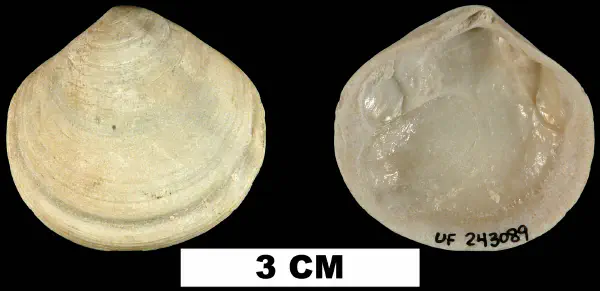
Scientific Classification
| Kingdom: Animalia |
| Phylum: Mollusca |
| Class: Bivalvia |
| Order: Cardiida |
| Family: Semelidae |
| Genus: Semele |
| Species: Semele proficua (Pulteney, 1799) |
Information
Geological Range
Paleogeographic Distribution
Stratigraphic Occurrences
| Falmouth Formation |
| Fort Thompson Formation [Questionable/rare] |
| Ironshore Formation |
| Jaimanitas Formation |
| Neuse Formation [Questionable/rare] |
| Bermont Formation [Common] |
| Caloosahatchee Formation [Uncommon] |
| Nashua Formation [Questionable/rare] |
| Waccamaw Formation [Questionable/rare] |
| Duplin / Raysor Formations [Questionable/rare] |
| Jackson Bluff Formation [Questionable/rare] |
| Mare Formation (Lower) |
| Raysor Formation |
| Tamiami Formation (Buckingham Limestone) [Questionable/rare] |
| Tamiami Formation (Pinecrest Beds) [Uncommon] |
Remarks
Common name: Atlantic semele.
Synonymy: n/a
Type specimen, locality, and stratum: n/a
Other voucher specimens: n/a
Descriptions:
First English Description (from Montagu, 1812, p. 66-67):
“T. with a sub-orbicular, sub-diaphanous shell, beset with numerous fine, regular, elevated, concentric ridges; the interstices or furrows crossed with minute striae, scarce discernible but by the help of a glass: umbo small. prominent, placed nearly central, and turns a little to one side: hinge with two small central teeth, and broad laminated lateral ones, projecting above the margin; from the apex a furrow runs on the inner side of the posterior lateral tooth, in which the connecting cartilage is fixed; colour yellowish-white. Inside smooth, glossy yellow: the tongue or cicatrix to which the animal is affixed, is broad, and runs into the middle of the shell; margin plain, beneath which is a depressed punctured line, parallel with the outer edge, not very conspicuous in younger shells. Length an inch and a quarter, breadth somewhat more.
We were favoured with this species by the Rev. Mr. Rackett, who said it was found rarely in Dorsetshire. Doctor Pulteney says on the north shore at Poole, and at Weymouth.
Chemnitz has given a very good figure of this shell, and quoted the Tellina reticulata of Linnaeus. Gmelin has not quoted Chemnitz’s figure, nor has he given any synonyms.”
To access this description in its original formatting through the Biodiversity Heritage Library, click here.
Measurements: n/a
Other remarks:
For information on the modern distribution of the species, see Malacolog and WoRMS.
References: n/a
Online resources:
Page history:
Some of the content on this page was originally published on the Neogene Atlas of Ancient Life on September 10, 2015. It was developed by Jonathan R. Hendricks and colleagues and migrated here in 2026.
This page was last modified on October 28, 2026 by Jonathan R. Hendricks.
Media
Images