Scientific Classification
| Kingdom: Animalia |
| Phylum: Mollusca |
| Class: Bivalvia |
| Order: Lucinida |
| Family: Lucinidae |
| Genus: Stewartia |
| Species: Stewartia floridana (Conrad, 1833) |
Information
Geological Range
Paleogeographic Distribution
Stratigraphic Occurrences
| Anastasia Formation [Uncommon] |
| Coffee Mill Hammock Formation [Uncommon] |
| Fort Thompson Formation [Common] |
| Pamlico Formation [Uncommon] |
| Bermont Formation [Common] |
| Caloosahatchee Formation [Common] |
| Nashua Formation [Uncommon] |
| Waccamaw Formation [Questionable/rare] |
| Duplin / Raysor Formations [Questionable/rare] |
| Jackson Bluff Formation [Questionable/rare] |
| Raysor Formation |
| Tamiami Formation (Pinecrest Beds) [Common] |
Remarks
Common name: Florida lucine.
Synonymy: n/a
Type specimen, locality, and stratum: n/a
Other voucher specimens: n/a
Descriptions:
Original Description (from Conrad, 1833, p. 344-345):
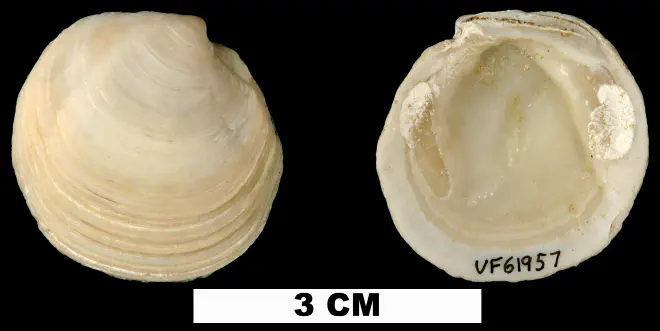
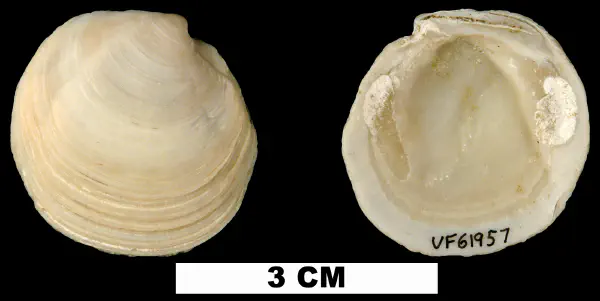
“Shell suborbicular, compressed, with regular concentric striae, and covered with a very thin pale brown deciduous epidermis; anterior and posterior sides each with an obscure fold; beaks central, not elevated; hinge edentulous; anterior muscular impression not greatly elongated. Length, one inch.
This shell resembles the fossil L. anodonta, of Say, but is very distinct. It was found near Pensacola by Dr. Hutchins, who sent it to Dr. S. G. Morton.”
To access this description in its original formatting through the Biodiversity Heritage Library, click here.
Measurements: n/a
Other remarks:
For information on the modern distribution of the species, see Malacolog.
References: n/a
Online resources:
Page history:
Some of the content on this page was originally published on the Neogene Atlas of Ancient Life on July 3, 2014. It was developed by Jonathan R. Hendricks and colleagues and migrated here in 2026.
This page was last modified on October 28, 2026 by Jonathan R. Hendricks.
Media
Images