Scientific Classification
| Kingdom: Animalia |
| Phylum: Mollusca |
| Class: Gastropoda |
| Order: Caenogastropoda incertae sedis |
| Family: Turritellidae |
| Genus: Torcula |
| Species: Torcula cookei (Mansfield, 1930) |
Information
Geological Range
Paleogeographic Distribution
Stratigraphic Occurrences
| Caloosahatchee Formation |
| Jackson Bluff Formation [Common] |
| Tamiami Formation (Pinecrest Beds) [Common] |
| Chipola Formation |
Remarks
Common name: n/a
Synonymy:
Previously listed as Turritella cookei on the Neogene Atlas of Ancient Life.
Type specimen, locality, and stratum: n/a
Other voucher specimens: n/a
Descriptions:
Original Description (from Mansfield, 1930, p. 107):
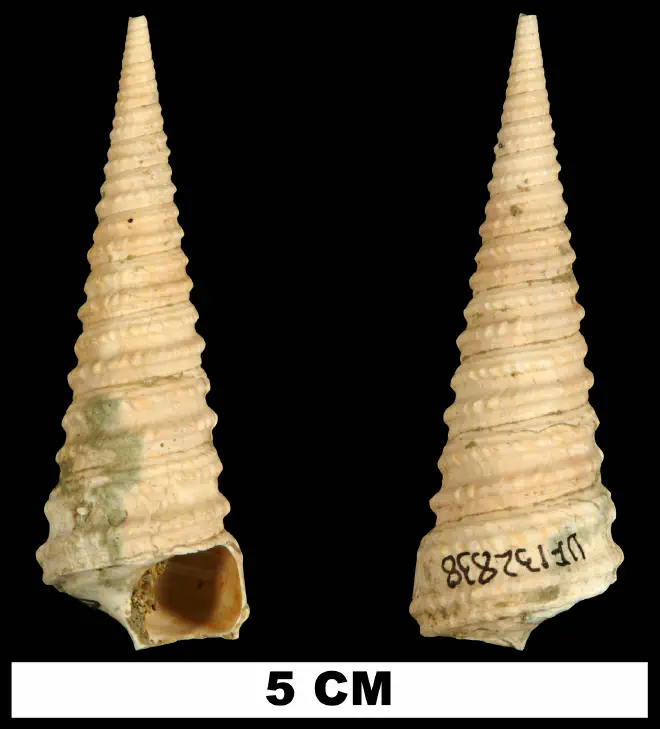
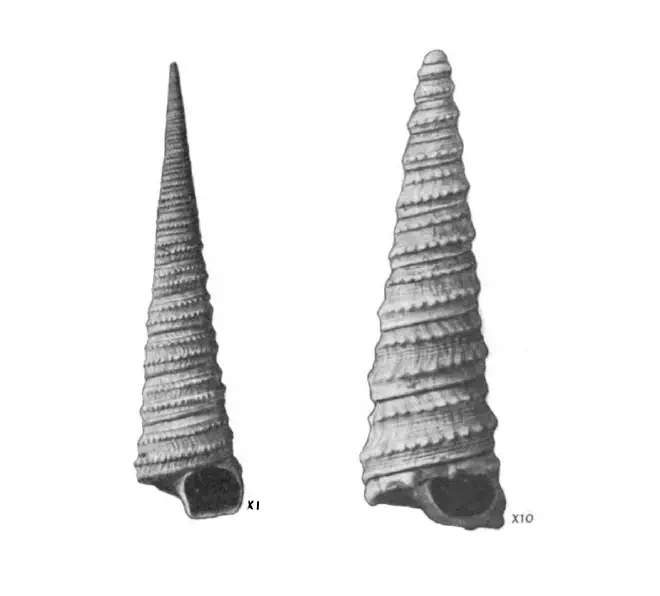
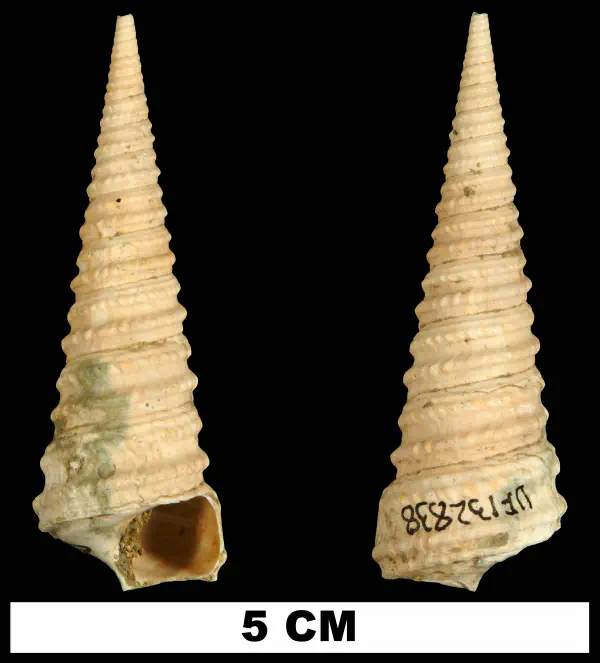
“Shell rather large, moderately stout, not strongly turrited, consists of 21 whorls on type; nucleus not preserved. Whorls subtrapezoidal in outline, weakly constricted at suture on earlier whorls and more strongly on later whorls. Apical turn smooth, rounded in outline, following three to four volutions carinated by a basal spiral. Sculpture on later whorls of 3 prominent, rounded, raised spirals; the upper spiral lies at the upper third; the following and strongest spiral lies at the lower third, being separated from the above spiral by a broad, slightly concave area; and the anterior spiral lies at the base of the whorl and weakly overhangs the suture. The two upper spirals are elongate-beaded or crenulated and the basal spire is nearly bare. Two to three very faint spirals lie in the medial area. A weak spiral lies between the posterior spiral and the upper suture. Base excavated below the basal spiral. Whole surface marked by microscopic incised spiral lines.
Type (U. S. Nat. Mus. Cat. No. 370345) measures: Altitude, 85 mm.; greatest diameter, 20 mm.
The description is based upon two specimens, the type and a paratype from a different locality, the latter with a well-preserved nucleus.
Turritella cookei, n. sp., is closely related to Turritella tuxtepecensis Bose but appears to have a much weaker spiral between the posterior primary and the upper suture than Bose’s species.
The new species is named in honor of Dr. C. W. Cooke, of the U. S. Geological Survey.
Occurrence: Upper Miocene: Station 3421, Harveys Creek, half a mile above abandoned mill, Leon County, type locality (common); station 1/422, Hamlin Pond, Washington County, paratype locality (abundant); station 1/955, Gully Pond, Washington County (rare).”
To access this description in its original formatting through Google Books, click here.
Measurements: n/a
Other remarks: n/a
References: n/a
Online resources:
Page history:
Some of the content on this page was originally published on the Neogene Atlas of Ancient Life on August 14, 2015. It was developed by Jonathan R. Hendricks and colleagues and migrated here in 2026.
This page was last modified on October 28, 2026 by Jonathan R. Hendricks.
Media
Images