Scientific Classification
| Kingdom: Animalia |
| Phylum: Mollusca |
| Class: Bivalvia |
| Order: Ostreida |
| Family: Ostreidae |
| Genus: Ostrea |
| Species: Ostrea carolinensis Conrad, 1832 |
Information
Geological Range
Paleogeographic Distribution
Stratigraphic Occurrences
| Chesapeake Group |
| Choptank Formation |
| Calvert Formation |
Remarks
Common name: n/a
Synonymy: n/a
Type specimen, locality, and stratum: n/a
Other voucher specimens: n/a
Descriptions:
Original description (from Conrad, 1832, p. 45):
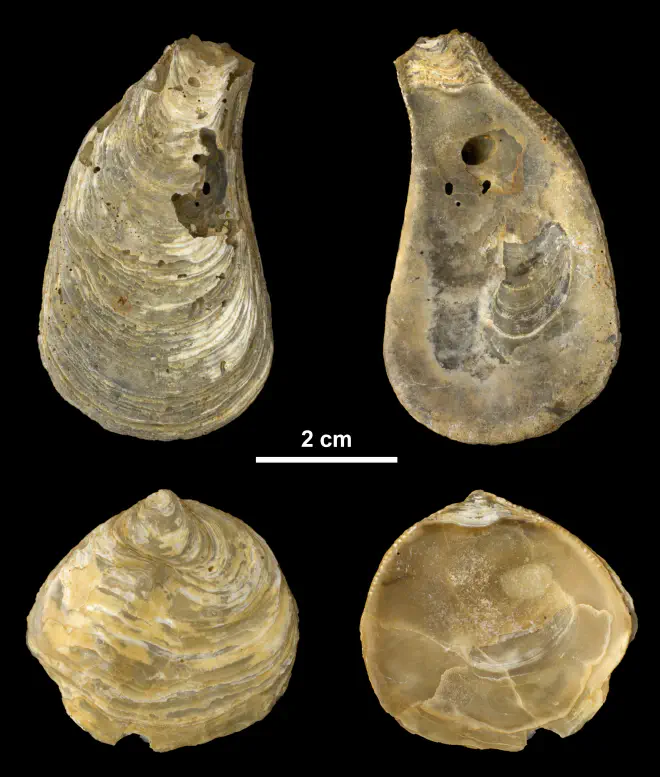
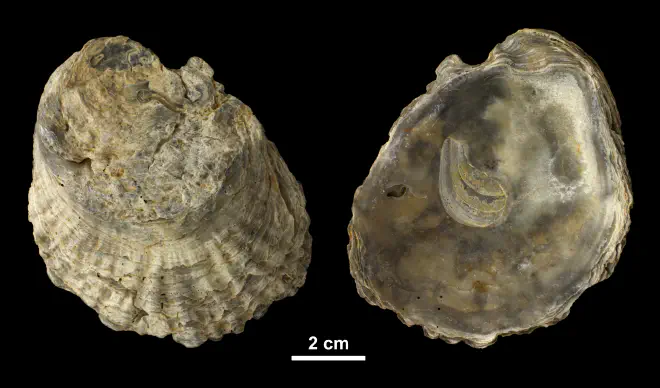
“Obovate, oblique, thick, compressed; superior valve flat inferior valve convex, with concentric imbricated laminae which are transversely plicated; beaks broad and prominent; fosset large and defined by broad prominent lateral ridges.
Locality. Santee Canal, S. C.
A large and handsomely plicated oyster, having considerable resemblance to O. compressirostra of Say, but the beaks in that species are very small and compressed, whilst in the former they are broad and prominent, and the shell attains a greater size and thickness with an approach to a falcate form.
Numbers were thrown up in excavating the Santee canal, and from its abundance in South Carolina, I have given the specific name Carolinensis. As I have not seen it in situ, and am ignorent [sic] of its accompanying fossils, I cannot positively refer it to the Middle Tertiary, to which it probably belongs.”
To access this description in its original formatting through the Biodiversity Heritage Library, click here.
Measurements: n/a
Other remarks:
Stratigraphic notes: Chesapeake Group: Formation unknown. Chesapeake Group: Age not resolved beyond “Miocene”. Choptank Formation: Age not resolved beyond “Miocene”.
References: n/a
Online resources: n/a
Page history:
Some of the content on this page was originally published on the Neogene Atlas of Ancient Life on October 19, 2016. It was developed by Jonathan R. Hendricks and colleagues and migrated here in 2026.
This page was last modified on October 28, 2026 by Jonathan R. Hendricks.
Media
Images