Scientific Classification
| Kingdom: Animalia |
| Phylum: Mollusca |
| Class: Bivalvia |
| Order: Ostreida |
| Family: Ostreidae |
| Genus: Ostrea |
| Species: Ostrea compressirostra Say, 1824 |
Information
Geological Range
Paleogeographic Distribution
Stratigraphic Occurrences
| Bear Bluff Formation [Questionable/rare] |
| Caloosahatchee Formation [Uncommon] |
| Chowan River Formation [Common] |
| Nashua Formation [Questionable/rare] |
| Waccamaw Formation [Common] |
| Duplin Formation [Common] |
| Duplin / Raysor Formations [Common] |
| Jackson Bluff Formation [Abundant] |
| Raysor Formation [Common] |
| Tamiami Formation [Common] |
| Tamiami Formation (Buckingham Limestone) [Uncommon] |
| Tamiami Formation (Murdock Station Member) [Questionable/rare] |
| Tamiami Formation (Lower) [Common] |
| Tamiami Formation (Ochopee Limestone) [Uncommon] |
| Tamiami Formation (Pinecrest Beds) [Common] |
| Yorktown Formation [Common] |
| Yorktown Formation (Mogarts Beach Clay) |
| Goose Creek Formation [Common] |
| Eastover Formation |
| St. Marys Formation |
Remarks
Common name: n/a
Synonymy: n/a
Type specimen, locality, and stratum: n/a
Other voucher specimens: n/a
Descriptions:
Original Description (from Say, 1824, p. 132-133):
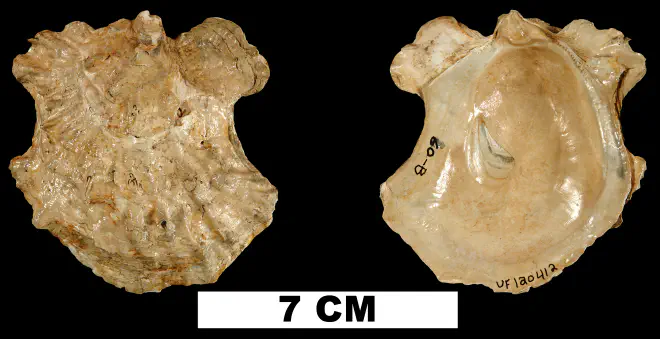
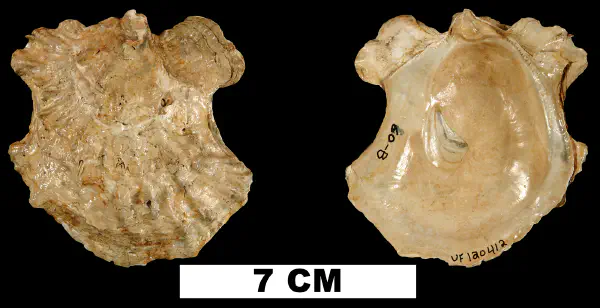
“Shell sinistral, subovate: inferior valve convex, with numerous convex ribs interrupted by fornicated scales at the lines of increment: hinge curving a little upward, very much contracted and short: superior valve flat, wrinkled concentrically, without any appearance of longitudinal lines: hinge more dilated than that of the superior valve, and oblique with respect to the thickness of the shell.
Length of the specimen four inches and four fifths; breadth four inches and a quarter. A large superior valve is five inches and three quarters long, and five inches and a quarter broad.
Like many species of this genus, it varies much in form, and in the prominence of the ribs on its convex valve; but these ribs are very obvious on the nine specimens under examination. Externally some varieties have a striking resemblance to O. bellovacina, Lam. but the hinge is much more contracted.
Besides those obtained by Mr. Finch, Mr. Z. Collins presented a fine specimen to the Academy, found on the west branch of the Potomac, about fifteen miles below Alexandria.”
To access this description in its original formatting through the Biodiversity Heritage Library, click here.
Measurements: n/a
Other remarks:
Stratigraphic notes: St. Marys Formation: Age not resolved beyond “Miocene”.
References: n/a
Online resources:
Page history:
Some of the content on this page was originally published on the Neogene Atlas of Ancient Life on August 12, 2014. It was developed by Jonathan R. Hendricks and colleagues and migrated here in 2026.
This page was last modified on October 28, 2026 by Jonathan R. Hendricks.
Media
Images